Direct answer, read this first
Hire a full-time DevOps engineer when DevOps has become daily work: deploys are manual and blocking releases, on-call is burning out your developers, reliability or compliance has become business-critical, or multiple teams are shipping every day. Before that point, outsourcing the work (DevOps as a service) usually gives you senior help faster and more cheaply than a full-time hire, without betting a salary on a role that is not yet full-time.
01The short answer
You hire a full-time DevOps engineer when the DevOps work has grown into a genuine full-time job and someone needs to own it in-house every day. Until then, you do not, and reaching for a permanent hire early is one of the more expensive mistakes a startup makes. The good news is that the signals are concrete, and there is a cheaper option that covers the gap in the meantime.
02You probably do not need one yet
If you are pre-launch, pre-revenue, or running a simple app with a handful of deploys a week, you almost certainly do not need a full-time DevOps engineer. Modern managed platforms handle a surprising amount on their own, and your developers can push to production without a dedicated specialist standing behind them. Hiring one at this stage means paying a senior salary for work that does not yet exist, and it is the same over-building instinct that has startups running Kubernetes before they have the traffic to justify it.
There is a real cost to hiring too early that is easy to miss: you create a single point of failure. When all your infrastructure knowledge lives in one person's head, their two-week holiday becomes a company risk. Early on, you are usually better off keeping things simple, keeping your infrastructure in code, and waiting for the work to actually arrive.
03The signs it is time
The need announces itself. Here are the concrete signals that DevOps has grown from a side task into real, ongoing work:
Deploys have become manual, slow, or scary
Releases wait on one person who knows the ritual.
On-call is burning out your developers
Incidents need heroics, and the same people keep getting paged at night.
Lead time is getting worse even as you add engineers
A classic sign that delivery, not headcount, is the bottleneck.
Your cloud bill is climbing
Nobody actually owns making it sane.
A compliance or security requirement has appeared
A SOC 2 request, a big customer's security review that needs someone to own it.
Multiple teams are shipping every day
Deployments, environments, and releases have become a constant stream of coordination.
One or two of these occasionally is normal. Several of them, consistently, is the work telling you it has become a full-time job.
04Decide with data, not vibes
If you want to replace gut feel with something you can point at, use the same delivery metrics a good DevOps team would. Watch your deployment frequency, your lead time for changes, your change failure rate, and your recovery time, the four DORA metrics we cover in the best-practices guide, plus one more that matters at a startup: your cloud cost per customer. When those trend the wrong way quarter over quarter despite your team's best efforts, the case for dedicated DevOps has made itself. Measuring your own trend beats reacting to a single bad week, and it gives you a concrete answer instead of an anxious one.
05The cheaper alternative: outsourcing and DevOps as a service
Here is the option most "should you hire" articles quietly skip, because it competes with the hire they want to sell you. Before a full-time engineer, most startups are better served by outsourcing the work, often called DevOps as a service or managed DevOps. You get senior, experienced help immediately, you can scale the effort up during a crunch and down when things are calm, and you avoid betting a full salary on a role that is not yet consistently full-time.
This is usually the runway-smart move at the early and seed stages. A good managed DevOps engagement sets up your pipelines, gets your infrastructure into code, keeps your costs sane, and hands you a working, documented setup, all without the recruiting cycle, the salary, and the single-point-of-failure risk of one internal hire. It also removes the dependency problem: the knowledge lives in code and documentation you own, not in one person you cannot afford to lose. When the work genuinely outgrows this model, you convert to a full-time hire from a position of strength, with your systems already in good shape.
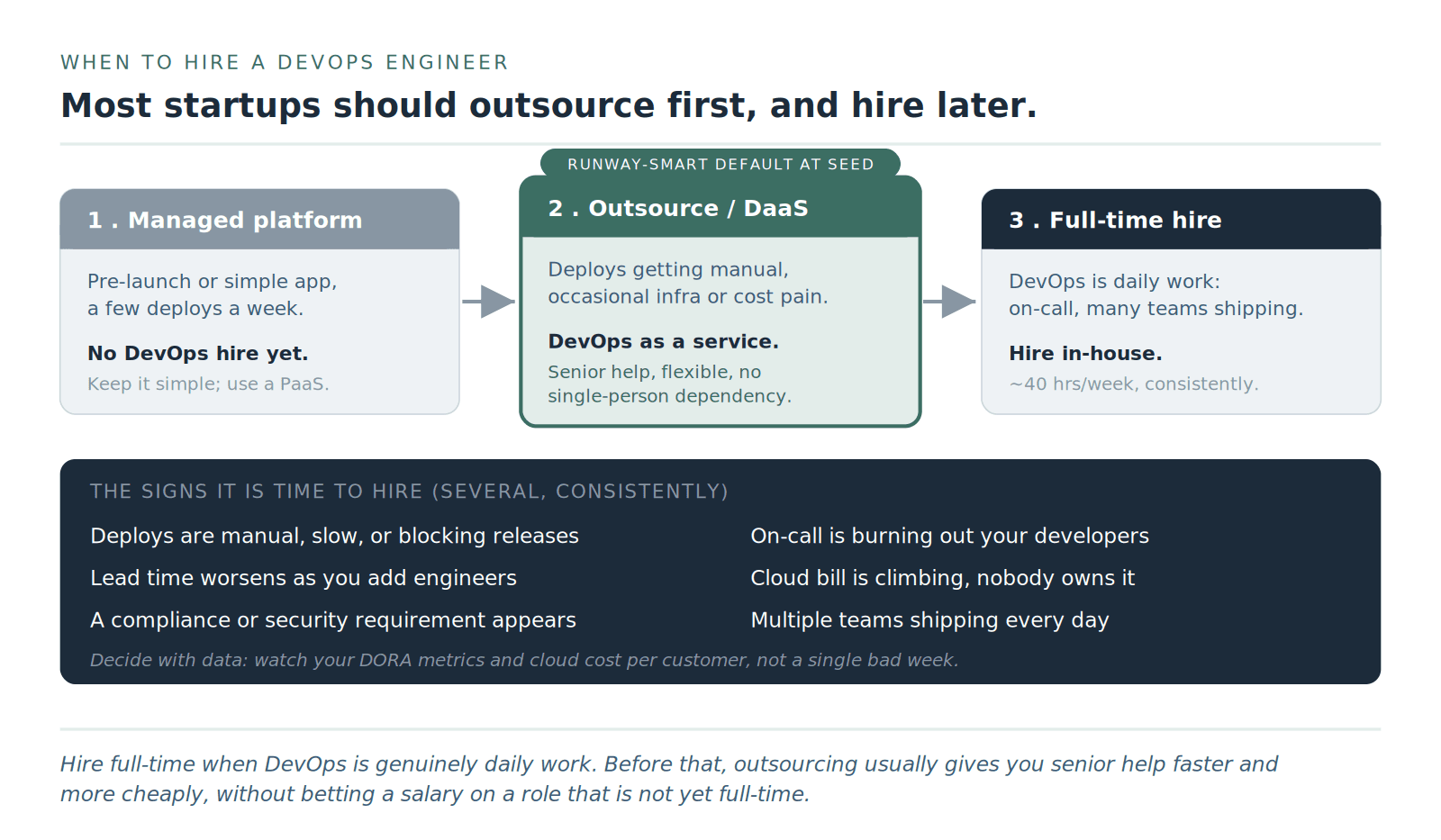
Outsource first, hire when DevOps becomes genuinely daily work. The signals below tell you when the line has been crossed.
06When a full-time hire actually makes sense
Outsourcing is not always the answer, and there is a clear point where a full-time hire wins. Bring someone in-house when DevOps is unmistakably daily work: you need round-the-clock reliability with real on-call rotations, you are dealing with frequent production issues that need someone available consistently, several teams are shipping constantly, or your setup has matured to the point where it needs ongoing, hands-on ownership rather than periodic help. Strict compliance regimes and genuinely complex systems also tip the balance toward in-house.
The honest test is simple: is this consistently about forty hours of work a week? If the honest answer is yes, and it will stay yes, hire full-time and be glad you are not deferring the decision again next quarter. If you are trying to squeeze forty hours of need into fifteen hours of a part-time arrangement, that does not work either, and it is its own signal.
07Outsourced or managed vs full-time
The choice is really about whether the work is continuous and needs an owner in the room, or periodic and outcome-shaped. Here is the quick version by situation.
| Your situation | The move | Why |
|---|---|---|
| Pre-launch or simple app, few deploys | Managed platform, no hire yet | The work does not exist yet; a hire would sit idle. |
| Deploys getting manual, occasional infra or cost pain | Outsource (DevOps as a service) | Senior help now, flexible, no single-person dependency. |
| Reliability or cloud cost a real, recurring problem | Outsource, or a first hire if the load is constant | Depends whether the work is periodic or daily. |
| DevOps is daily work: on-call, many teams shipping | Full-time hire (or a managed retainer) | It is now a real full-time job that needs an owner. |
| Strict compliance or complex systems, ~40 hrs a week | Full-time hire, maybe a small team | Deep, continuous, in-house ownership required. |
08If you are not ready to decide
If you are genuinely on the fence, two things keep your options open and cost you almost nothing. First, get your infrastructure into code now, regardless of who runs it; infrastructure as code is business insurance against losing the one person who knows how everything works. Second, whatever help you bring in, outsourced or hired, keep control of your own cloud accounts, CI systems, and secrets, and tie any engagement to clear outcomes and a handover plan. That way you are never locked in, and you can change models as your needs change without starting over.
One more piece of honesty worth the detour: a lot of roles posted as "DevOps engineer" are really platform or SRE roles wearing the wrong label. Before you write a job description, decide what actually breaks if the role stays empty, and the right title usually names itself.
09So, should you hire?
If DevOps has become daily work, deploys are blocking you, on-call is hurting your team, or reliability and compliance are now business-critical, yes, it is time, and you can look at what to screen for and start hiring. If you are earlier than that, which most readers are, outsource the work, keep your runway, and revisit when the signals above start stacking up. Either way, the honest answer comes from the amount of real work in front of you, not from a job board.
Not sure which side of the line you are on?
Tell us your stage, team size, and what is hurting, and we will give you a straight answer, including if it is "outsource for now, do not hire yet."
Contents
Frequently Asked Questions
Common questions about hiring DevOps engineers
Quick answers to the most common questions.
01How do I know if I need a DevOps engineer?
02Does a small startup or small company need DevOps?
03What is DevOps as a service?
04Is it cheaper to outsource DevOps than to hire?
05When should I hire a full-time DevOps engineer instead of outsourcing?
06Can I just use a managed platform instead of hiring?
07Should my startup outsource DevOps or build it in-house?
On the fence about hiring?
Tell us your stage and what is hurting, and we will give you an honest read, including if the answer is "not yet."
No pressure. Just a conversation to see if we're a good fit.