Direct answer, read this first
You need DevOps investment once shipping starts pulling engineers off the product. The maturity model makes that precise instead of a gut feel. Most SaaS startups should aim for level three of five, defined and automated, not the top level. Score yourself with the DORA-based self-assessment below in about ten minutes, no paid tool required.
01The short answer
You need DevOps investment once your current way of shipping starts pulling engineers off the product. Before that point, more process is usually premature. The maturity model just makes "how good is our current way" precise instead of a gut feel.
Most SaaS startups should aim for level three of five: defined and automated, not exhaustively measured and self-optimizing. Levels four and five earn their keep at scale, when you have the team and the traffic to justify the overhead. Chasing them early is a common and expensive mistake, and we will come back to why.
02What a DevOps maturity model actually is
A DevOps maturity model is a framework for rating how advanced your software delivery is, across a few dimensions: how you build and release, how you run infrastructure, how you catch and recover from problems, and how the team is organized around all of it.
The five-level structure most models use (Initial, Managed, Defined, Measured, Optimized) traces back to CMMI, the Capability Maturity Model Integration that predates DevOps by decades. Different vendors relabel the levels, but the shape is consistent: each level describes a team that has automated and systematized more of its delivery than the one below it.
Two other frameworks come up alongside it. CALMS (Culture, Automation, Lean, Measurement, Sharing) is a checklist of the dimensions maturity should cover, a reminder that this is not only about tooling. And DORA's four metrics give you the measurement layer, which turns a vague model into something you can score yourself against. We will use DORA for exactly that in section four.
03The five levels, translated for a startup
Here is the model in terms a founder can map onto their own team. The DORA column describes a typical profile at each level; treat those as rough ranges, not hard cutoffs, because real teams straddle levels.
| Level | What it looks like day to day | Typical DORA profile |
|---|---|---|
| 1. Initial | Manual, stressful deploys. One person knows prod. Releases are events. | Monthly or slower; recovery in hours to days |
| 2. Managed | Basic CI runs tests. Some scripts. Deploys still need babysitting. | Every few weeks; recovery in hours |
| 3. Defined | Automated, repeatable releases. Infrastructure in code. Monitoring exists. | Weekly to daily; recovery under an hour |
| 4. Measured | You track DORA metrics and act on them. Failures rare, caught fast. | Daily or on demand; recovery in minutes |
| 5. Optimized | Continuous improvement is a habit. The platform mostly runs itself. | Elite across all four metrics |
Note: The levels are cumulative: you do not skip. A team at level one gains far more from reaching level three than a level-three team gains from reaching level five.
04Assess yourself in ten minutes, no tool required
Vendors sell maturity assessments. You do not need one to get a useful answer. Run your team against these questions honestly, and the pattern tells you your level.
Can you deploy with one action?
If shipping to production is one merge or one command, you are at least at level two, probably three. If it takes a checklist and a nervous person, you are at level one.
Is your infrastructure in code?
If you can rebuild your environment from a repository, that is level-three behavior. If it lives in someone's memory and the AWS console, you are below it.
Do you find out about problems before your users do?
Real monitoring and alerting is the level-three line. A customer email as your alerting system is level one, regardless of how good your pipeline is.
Do you track the four DORA metrics and change what you do based on them?
Measuring deploy frequency, lead time, change failure rate, and time to restore, and acting on the numbers, is what separates level four from level three.
Is improvement a routine, not a project?
If tightening delivery happens continuously rather than in occasional heroic pushes, that is level five.
Count where the honest answers stop being yes. That is your level. Most SaaS startups doing this exercise land at one or two and are surprised they are not higher; that gap, between where you are and where you assumed you were, is usually the real reason someone told you that you need DevOps.
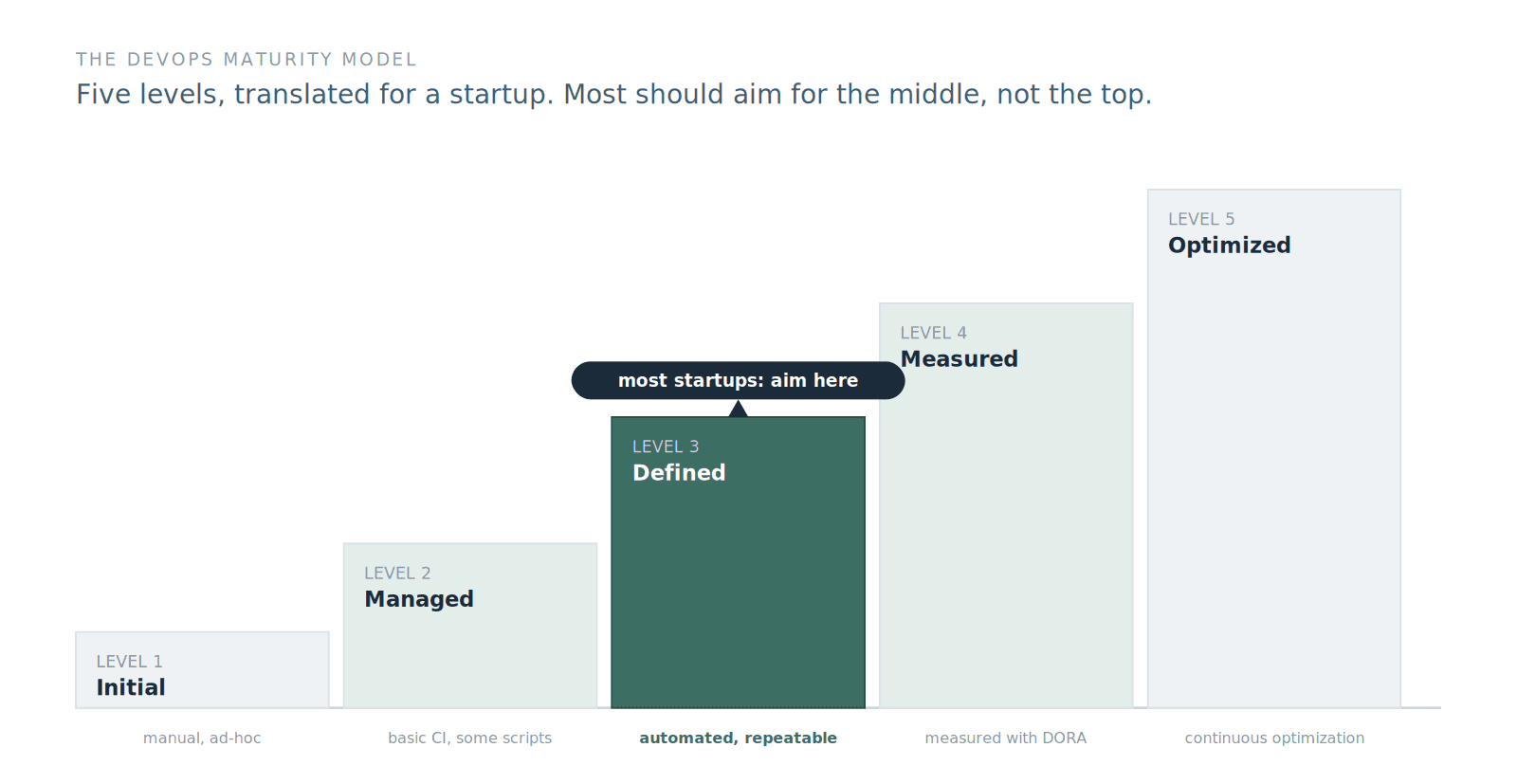
The five levels as a staircase. The value is in the climb from level one to level three; most startups should aim for the middle, not the top.
05What level should a startup actually aim for?
Level three. Defined and automated. That is the target for most SaaS companies, and stopping there deliberately is a strategy, not a compromise.
Here is the reasoning. The jump from level one to level three is where nearly all the value lives: automated deploys, infrastructure as code, and real monitoring together take shipping from a stressful event to a routine non-event. That is the change that stops infrastructure from pulling engineers off the product, which was the whole reason to invest.
Levels four and five add measurement discipline and continuous optimization. Those are real benefits, but they carry real overhead, and that overhead only pays back when you have the scale to amortize it: enough deploys that tracking metrics changes decisions, enough traffic that shaving recovery time from minutes to seconds matters, enough engineers that a platform investment serves many teams. A ten-person startup that builds a level-five setup has usually spent months gold-plating a system for a scale it does not have yet.
Aim for three. Reach four when your metrics start telling you things you would otherwise miss. Reach five when you have a platform team to own it.
06Maturity is not the same as buying more tools
The most common way teams misread this model is to treat a higher level as a shopping list. Buy the observability platform, add the service mesh, adopt Kubernetes, and surely that is level four.
It is not. Maturity is about how reliably and repeatably you ship, not how much tooling you own. A team with a boring, automated, well-monitored deploy on a managed platform is more mature than a team with a sophisticated Kubernetes setup that only one person understands and that breaks in ways nobody can debug. The second team bought level-five tools and operates at level one.
This is why the CALMS framework leads with Culture and ends with Sharing, with Automation as only one letter in the middle. If shared ownership of production is not there, no tool supplies it. Adding complexity ahead of maturity just gives you a more expensive way to have the same problems.
07How to level up from where you are
The move depends on where the self-assessment put you.
Level 1→Level 2
The highest-leverage fix is a single automated deploy path: one merge to production, with tests and a rollback. Everything else compounds off it, and it is usually a few weeks of focused work. This is the core of CI/CD pipeline setup.
Level 2→Level 3
You have CI but releases still need babysitting. The step up is automating the full release and getting your infrastructure into code, so environments are reproducible rather than hand-built.
Level 3→Level 4
The work is monitoring and observability and starting to track DORA metrics so you are deciding from data, not instinct.
You do not need a platform team to reach level three. You need someone who has done it before and can set it up properly the first time. That can be an in-house DevOps engineer you hire, or managed DevOps if you would rather not pull focus from the product.
Not sure which level you are at?
Tell us where you are stuck and we will give you an honest read, including if the answer is that you are fine where you are for now.
Book a free technical call08Where this is heading in 2026
Two shifts are worth knowing about, though neither changes the advice above for a startup.
Platform engineering
The direction maturity is evolving at scale: larger organizations are building internal platforms so product teams can ship without touching infrastructure directly. It extends the maturity model rather than replacing it, and it is a level-four-and-five concern. For a startup at level one or two, it is a distraction.
AI-assisted development
Maturity models are starting to account for how teams govern AI-assisted development, as more code gets written with AI help. That is an emerging direction rather than a settled practice, and worth watching rather than acting on yet. If you adopt AI coding tools, watch whether your change failure rate creeps up even as you ship faster, which is the same discipline the maturity model has always asked for.
Contents
Frequently Asked Questions
Common questions about DevOps maturity
Quick answers to the most common questions.
01Do I need DevOps for my SaaS product?
02What is a DevOps maturity model?
03What are the DevOps maturity levels?
04How do I assess my DevOps maturity?
05What DevOps maturity level should a startup aim for?
06Is a DevOps maturity model the same as DevOps automation?
07What frameworks are used for DevOps maturity?
08Does my SaaS need Kubernetes to be DevOps-mature?
Want an outside read on your maturity?
Tell us where you are stuck and we will place you on the model honestly, including if you are fine where you are.
No pressure. Just a conversation to see if we're a good fit.