DevOps is a way of building and running software where the people who write the code and the people who operate it work as one team, using automation to release small changes often and safely. It's less a tool than a shift in how a team works.
The goal is simple: ship faster without breaking production.
01The 5pm Friday problem
Picture a small SaaS team on a Friday afternoon. A change is ready, it's been sitting for a week, and someone finally deploys it. The site goes down. Nobody's quite sure why, the person who wrote the change has left for the weekend, and there's no quick way to undo it. Everyone stays late.
If that feels familiar, you've met the problem DevOps was invented to solve. For years, the people who built software and the people who ran it sat in separate teams with separate incentives. Developers were rewarded for shipping features; operations was rewarded for keeping things stable. So developers threw finished code "over the wall" to operations, who then had to run something they hadn't seen before. Releases became big, rare, and terrifying, which made them riskier, which made teams release even less often. A vicious circle.
DevOps breaks that circle by putting both sides on the same team, with shared ownership of the whole journey from idea to production and beyond.
02What DevOps actually means
DevOps is a culture of shared ownership, supported by automation, that lets a team release small changes continuously and recover quickly when something breaks.
Two things in that sentence do the heavy lifting:
- •Culture. DevOps is first a way of working: collaboration, shared responsibility, and learning from failure instead of hunting for someone to blame. You can buy every tool on the market and still not have DevOps if the team dynamics don't change.
- •Automation. The culture is made practical by automating the repetitive, error-prone steps building, testing, and deploying code so releases stop depending on one person remembering the right sequence at 5pm on a Friday.
03How DevOps works: the lifecycle
Because the work never really "finishes" (you build, run, learn, and improve continuously), the DevOps lifecycle is usually drawn as an infinity loop with eight phases:
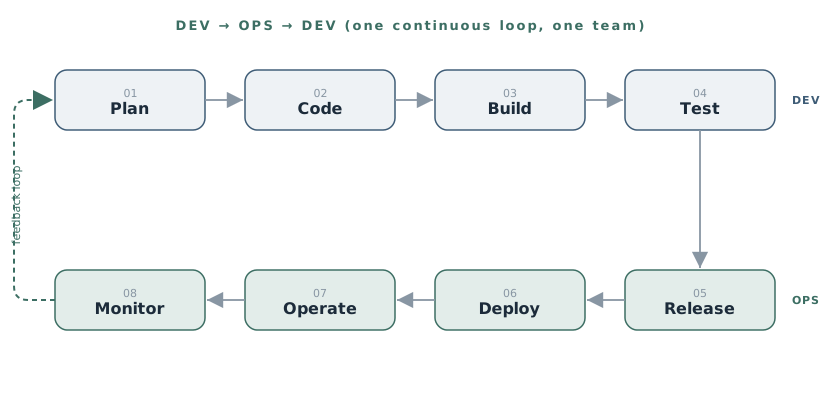
The DevOps lifecycle: one continuous loop, one team
Decide what to build and why
Tools: Jira, Linear
Write it in small pieces, in version control
Tools: Git, GitHub, GitLab
Compile and package it automatically
Tools: Maven, Gradle, Docker
Run automated checks on every change
Tools: PyTest, Jest, Selenium
Ready a validated change for production
Tools: GitHub Actions, Jenkins, GitLab CI
Push to production, ideally with one click
Tools: Argo CD, Helm, Spinnaker
Run it reliably at scale
Tools: Kubernetes, AWS, Terraform
Watch behaviour, feed it back into planning
Tools: Prometheus, Grafana, Datadog
04The core practices that make it real
A handful of practices turn that loop from a diagram into something that runs:
CI/CD
Learn more →The engine of DevOps. Continuous integration and continuous delivery/deployment means every code change is merged, tested, and flows to production automatically.
Infrastructure as Code
Learn more →Define your servers, networks, and databases in version-controlled code. Your environment becomes repeatable, reviewable, and easy to rebuild.
Automation
Learn more →Anything a human does the same way twice is a candidate to be automated: builds, tests, provisioning, deployments, even rollbacks.
Monitoring & Observability
Learn more →You can't fix what you can't see. Good monitoring tells you something's wrong before your users do, and gives you the data to find out why.
DevSecOps
Learn more →Security checks built into the pipeline rather than bolted on at the end. Scanning code, dependencies, and secrets automatically catches problems early.
05DevOps is a culture, not a job title
CALMS: Culture, Automation, Lean, Measurement, Sharing
Teams talk to each other instead of filing tickets across a wall; work happens in small batches so problems are small too; decisions are backed by measurement rather than opinion; and when something breaks, the team runs a blameless post-mortem to fix the system, not to punish the person.
This is also why "hiring a DevOps engineer" and "doing DevOps" aren't the same thing. A good DevOps engineer builds the pipelines and infrastructure that make the culture possible, but the culture still has to be adopted by the whole team.
06Why DevOps matters for startups and SaaS teams
For an early-stage or scaling company, the benefits are less abstract than the textbooks make them sound:
Ship faster
Features reach users in days, not months
Releases stop being scary
Automated tests and reliable rollback paths
Downtime goes down
Monitoring plus fast recovery means fewer outages
Cloud bills get predictable
See what you're running and switch off what you're not
Team scales without breaking
Repeatable processes mean onboarding is smooth
07How you know it's working: DORA metrics
"We feel faster" isn't evidence. The most widely used way to measure DevOps performance is the set of metrics from DORA (DevOps Research and Assessment), drawn from the Accelerate research. There are four classic keys, and they're deliberately balanced so you can't win one by sacrificing another:
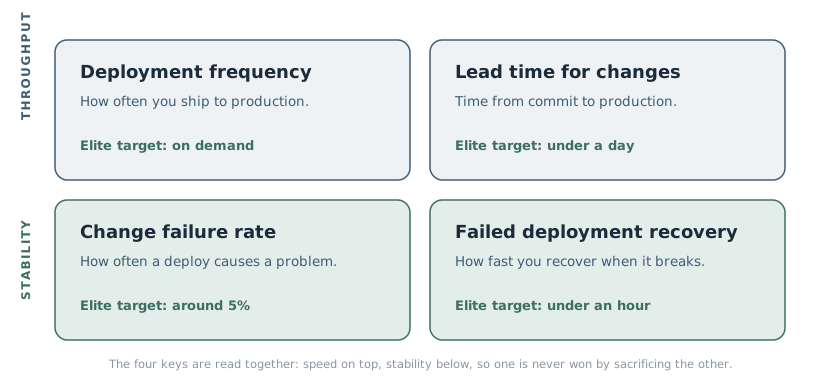
The four keys are read together: speed on top, stability below
Elite
On demand (many times a day)
⏱️ Less than a day
🔄 Less than an hour
High
Once a day to once a week
⏱️ One day to one week
🔄 Less than a day
Medium
Once a week to once a month
⏱️ One week to one month
🔄 Less than a day
Low
Less than once a month
⏱️ More than a month
🔄 Over a week
*Approximate tiers from the 2024 DORA / Accelerate State of DevOps Report. Elite teams maintain change failure rates around 5%.
08Where DevOps is heading in 2026
Platform Engineering
As teams grow, "you build it, you run it" starts to overload developers with infrastructure work. Platform engineering builds an internal, self-service platform so product engineers can ship without becoming cloud experts.
*Source: Gartner, 2025-2026 projections
AI in the Pipeline
AI is moving into CI/CD summarising failed builds, suggesting fixes, flagging risky changes. The sensible pattern is AI assisting engineers, not making the final call.
GitOps: Using Git as the single source of truth for your infrastructure. Small changes, automated, observable, reversible.
09Do you actually need DevOps yet?
The honest version: Not every team needs the full machinery on day one.
If you're a solo founder with a prototype and no users, you don't need a DORA dashboard you need to find product-market fit. What you do want early is the cheap, high-leverage basics: a simple automated deploy, version-controlled infrastructure, backups, and a bit of monitoring. That's often called minimum viable DevOps.
You've probably outgrown "we'll deal with it later" when you notice the signs: deployments are manual and nerve-wracking, you've had avoidable downtime, cloud costs are creeping up with no clear owner, releases are slowing down as the team grows, or there's simply no one whose job it is to keep production healthy.
If a few of those hit home, the next step is a conversation, not a rebuild.
Book a free technical callContents
Frequently Asked Questions
Common questions about DevOps
Quick answers to the most common DevOps questions.
01What is DevOps in simple terms?
02Is DevOps a tool or a process?
03What problems does DevOps solve?
04Do startups need DevOps?
05What's the difference between DevOps and Agile?
06What does a DevOps engineer do?
07When should a startup adopt DevOps?
Need help implementing DevOps?
Book a free technical call and we'll tell you honestly what's worth doing now and what can wait.
No pressure. Just a conversation to see if we're a good fit.