Direct answer, read this first
The real benefit of DevOps is that shipping stops being an event. When releases are automated, small, and reversible, you ship faster, each release carries less risk, outages get shorter, and engineers stop losing days to manual work. Measure it with the four DORA metrics against your own baseline. Ignore the 285% ROI and 208x deployment claims that fill most pages on this topic, because they cannot be traced to a published method.
01What does DevOps actually change for a startup?
You've got a release ready. It's been ready for nine days. It's sitting on a branch because the last deploy took the API down for forty minutes on a Tuesday afternoon, and nobody wants to be the person who does that twice in one month. So it waits, and while it waits it grows, because two more people merged into it. By the time it ships it will be even bigger and even scarier, which is exactly why it will wait a bit longer.
That loop is the thing DevOps is actually for. Not the tooling, not the org chart, not the word itself. The loop.
DevOps is a way of building and running software where the people who write the code also own how it gets tested, deployed, and kept alive, and where as much of that path as possible is automated. Everything else is implementation detail. The practical effect is that a release stops being a thing you schedule, brace for, and recover from, and becomes a thing that happens several times a day without anyone noticing.
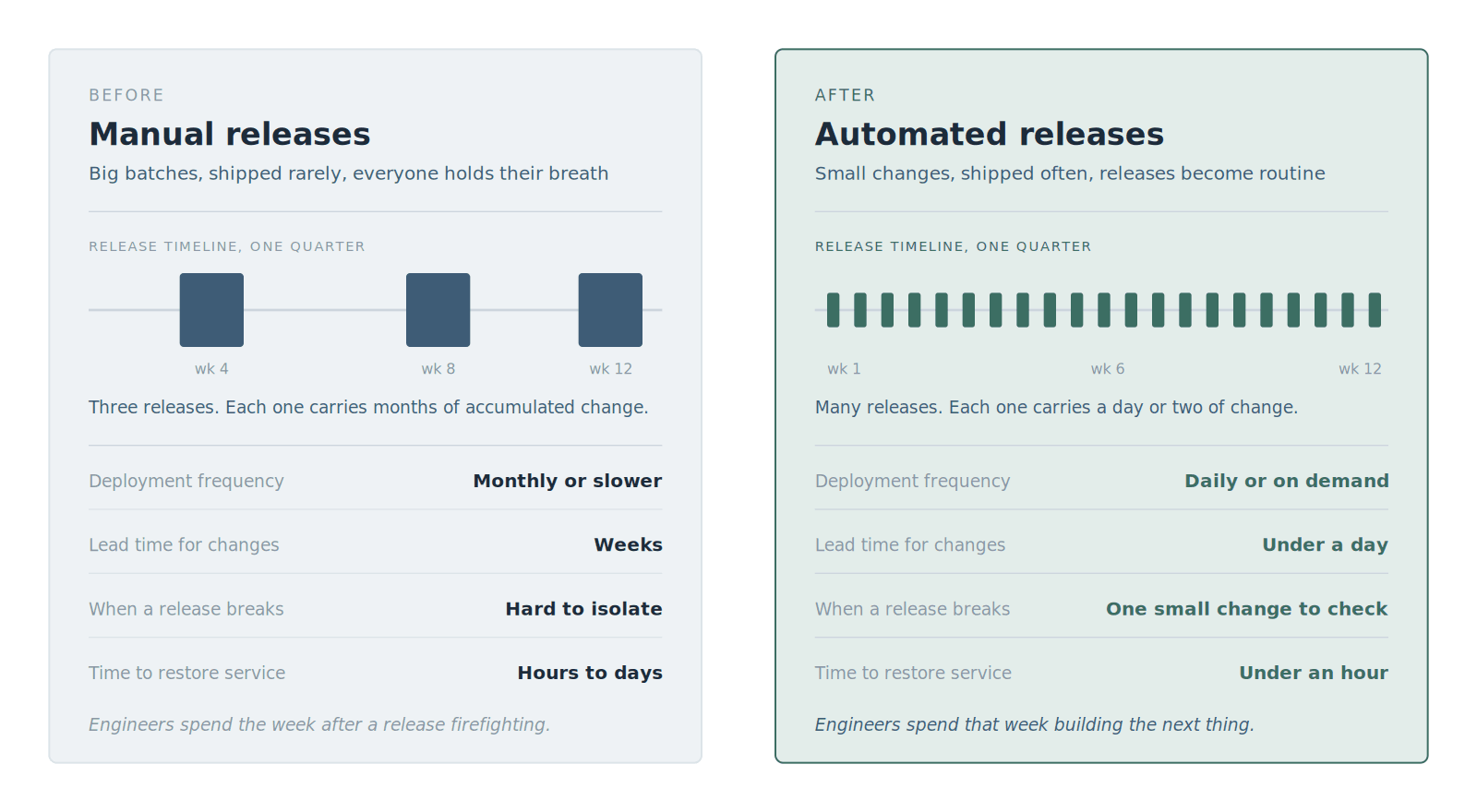
The same quarter, two ways of working. Small frequent changes are easier to test, easier to debug, and cheaper to reverse than large infrequent ones.
02How much faster will you really ship?
Nobody types faster. What changes is the dead time between a change being finished and that change being in front of a user.
In a manual setup, that gap fills with waiting: for a QA window, for a deploy slot, for someone with production access to be awake. Automate the build, test, and deploy path and most of that waiting disappears. Teams that do this well move from shipping every few weeks to shipping daily, sometimes hourly.
The commercial version of this benefit is that your feedback loop shortens. You find out whether a feature was a good idea in days instead of a quarter. For a startup still working out what to build, that is worth considerably more than the engineering hours it saves. This is mostly a CI/CD pipeline problem, and it is usually the first thing worth fixing.
03Why do frequent releases reduce risk?
This is the counterintuitive part, and it is the finding DORA's research has replicated for the better part of a decade: shipping more often makes shipping safer.
It sounds backwards until you think about batch size. A release containing three days of work has a small surface area. If it breaks something, there are only a handful of changes to look at, and reverting costs you three days. A release containing nine weeks of work from six engineers has an enormous surface area, and reverting it means throwing away nine weeks. So you do not revert it. You debug it live, at 11pm, with customers watching.
Speed and stability are not a trade-off. Teams tend to be good at both or bad at both, which is why "we will slow down to be more careful" usually makes things worse.
04What happens to downtime?
You will still have incidents. Anyone who tells you otherwise is selling something. What changes is how long they last.
When deploys are automated and reversible, when infrastructure is defined in code you can rebuild from, and when you have real monitoring rather than a customer email as your alerting system, an outage becomes a twenty-minute problem instead of a six-hour one.
The mechanism is boring and it is the whole point: you can see what broke, you know what changed, and you can put it back. Those three things come from monitoring and observability, infrastructure as code, and an automated deploy path respectively.
05What do your engineers get back?
Every hour a senior engineer spends manually provisioning a staging environment or hand-patching a server is an hour not spent on your product. At a ten-person company that is a meaningful fraction of your total engineering capacity.
There is a retention argument too, and it is not a soft one. Engineers leave jobs where they get paged constantly and spend their days on repetitive infrastructure work. Replacing a senior engineer costs you months. This benefit is real, though it is the hardest one on this list to put a number against, so be suspicious of anyone who gives you a precise one.
06Does DevOps reduce cloud costs?
It makes them predictable, which is not quite the same thing. Sometimes the bill goes down. Sometimes it goes up because you were under-provisioned and did not know.
What these practices give you is visibility and control. When infrastructure is defined in code, you can see what you are running. When it is tagged, you can see what each service costs. When it auto-scales, you stop paying peak capacity around the clock. When environments are disposable, your staging setup stops running all weekend for no reason.
We are deliberately not putting a percentage on this. It depends entirely on how your infrastructure looks today, and any number we invented would be exactly the kind of claim the next section exists to push back on.
07How do you measure the benefits?
The DORA research program, now run at Google, spent a decade identifying which measures of software delivery correlate with business outcomes. It landed on four, two for speed and two for stability. They are the most defensible framework available, and they are free to adopt.
| Metric | What it tells you | 2024 elite benchmark |
|---|---|---|
Deployment frequency | How often you get changes to users | On demand, multiple times a day |
Lead time for changes | Commit to running in production | Less than one day |
Change failure rate | Share of releases that cause a problem | Around 5% |
Time to restore service | How fast you recover from failure | Less than one hour |
Note: Benchmarks are from the 2024 DORA report, the last edition published in the four-tier format. Roughly one in five surveyed teams qualified as elite. DORA has since added a fifth measure, so treat these four as the stable foundation and check dora.dev for the current framing.
Measure your own trend.
Compare against your own baseline from three months ago rather than against industry benchmarks. A team going from monthly to weekly deploys is winning regardless of what elite looks like.
Do not compare engineers.
Nathen Harvey, who leads DORA at Google Cloud, has been explicit that these are not meant for weighing teams against one another. Used as a scoreboard, throughput metrics get gamed within a quarter.
08Why are the usual DevOps statistics wrong?
Search this topic and you will be told DevOps delivers 285% ROI, that elite teams deploy 208 times more frequently, that 99% of companies report a positive impact, and that infrastructure costs reliably drop 20 to 30%. We are not using any of those.
| The claim | Where it comes from | What we use instead |
|---|---|---|
| 285% ROI | Vendor marketing with no published methodology | No ROI multiple at all |
| 208x more deployments | An elite versus low comparison from one survey year, quoted without context | Your own deployment frequency trend |
| 99% report benefits | A self-reported, vendor-sponsored survey | DORA benchmarks you measure yourself |
| Costs drop 20 to 30% | Untraceable to any described method | Predictability, measured on your own bill |
Note: The DORA multipliers are the worst offenders. You will see 46x, 208x, 440x, 106x, and 182x circulating at the same time, because each came from a different report year and none of them travels with that context.
Here is the part that gets left out. Between the 2023 and 2024 DORA reports, industry performance got worse, not better. The low-performing group grew from roughly 17% to 25% of respondents, while the high-performing group shrank from about 31% to 22%. If DevOps automatically delivered the returns those pages describe, that could not happen.
And in 2025, DORA replaced the familiar elite, high, medium, and low tiers entirely, moving to seven team archetypes that account for things like burnout and friction alongside delivery performance. The two ends of that range are labeled "foundational challenges" and "harmonious high achievers." The report was also renamed to reflect its new focus on AI-assisted development. Most articles on DevOps benefits still describe the old four-tier model as current.
So what is defensible? The finding from the Accelerate research that high performers are roughly twice as likely to meet or exceed their organizational goals. Twice, not 208 times. That is a real, useful, appropriately modest claim, and it is the one we would build a business case on.
09What are the real challenges?
DevOps has costs, and they are front-loaded.
It takes real time before it pays off.
You are building pipelines, writing infrastructure code, and setting up monitoring while also shipping product. The first few months are pure investment. Anyone promising results in week two is describing a demo, not a migration.
The hard part is people, not tooling.
Every tool in this space is well documented. What is difficult is getting developers to own production, getting ops-minded people comfortable with automation replacing manual control, and getting leadership to fund work with no visible feature attached. Most stalled DevOps efforts stalled here.
You can automate the wrong things.
Teams build elaborate pipelines around a deployment process that was badly designed to begin with, and end up with a faster route to the same bad outcome. Fix the process, then automate it.
Tooling sprawl is real.
It is easy to end up with a CI tool, a separate CD tool, three monitoring products, and two secret managers, none of which quite talk to each other. Each was a reasonable decision at the time.
AI is currently distorting these measurements.
The 2025 DORA research found AI adoption correlating positively with delivery throughput but negatively with stability. Your deployment frequency can rise because AI helps ship more small changes, while your change failure rate quietly rises too. Watch both together or you will congratulate yourself on the wrong thing.
10What will DevOps not fix?
It will not tell you what to build.
A team that ships the wrong thing weekly instead of quarterly is failing faster, which is only an improvement if you are actually reading the feedback.
It will not replace engineering judgment.
Automated tests catch what you thought to test for.
It will not fix a broken team.
If your engineers do not trust each other, shared ownership of production makes that worse, not better.
It will not make Kubernetes the right answer.
Most early-stage startups do not need it, and managed platforms are usually the better call until scale genuinely demands otherwise.
11Where should you start?
If you are a small team with none of this in place, the order that tends to work is:
Automated deploys first.
One merge gets you to production and everything else can compound off it.
Monitoring.
So you find out about problems before your users tell you.
Infrastructure as code.
So your environments are reproducible.
Security in the pipeline.
Once there is a pipeline to put it in.
You do not need a platform team to do this. You need someone who has done it before, for long enough to set it up properly the first time. That can be us, or it can be a DevOps engineer you hire who has run production systems at your stage.
Want this set up properly?
If you would rather have your pipelines, infrastructure, and monitoring built without pulling engineers off product work, that is what our managed DevOps and DevOps for startups work are for, and we will tell you honestly if you are not ready yet.
Book a free technical callContents
Frequently Asked Questions
Common questions about DevOps benefits
Quick answers to the most common questions.
01What are the main benefits of DevOps?
02Is DevOps worth it for a small startup?
03Does DevOps actually reduce costs?
04How long does DevOps take to show results?
05What is the difference between DevOps and CI/CD?
06Do we need Kubernetes to get the benefits of DevOps?
07What are the biggest DevOps challenges?
08How do we measure whether DevOps is working?
Not sure whether you need this yet?
Tell us what is breaking and we will give you an honest answer, including if that answer is not yet.
No pressure. Just a conversation to see if we're a good fit.