Direct answer, read this first
A DevOps engineer builds and runs everything between a developer finishing code and a customer using it: CI/CD pipelines, cloud infrastructure and infrastructure as code, automation, monitoring, security, and increasingly cloud cost. In the US they typically earn around $80,000 to $200,000 or more depending on experience. You do not always need a full-time one; for many startups, fractional or managed DevOps is a better fit than a single expensive hire.
01What problem does a DevOps engineer solve?
Picture where a lot of startups land around their first real growth. The product works. Your two or three developers are shipping features. But deploys take a whole afternoon, the staging environment broke again last week, and the site went down for an hour before anyone noticed. Your developers are spending more time fighting infrastructure than building the thing customers pay for.
Somewhere in there, you started hearing that you need to "hire a DevOps engineer." The question is what that person would actually own once they arrived.
02What does a DevOps engineer actually own?
The simplest way to think about it: everything that happens between a developer finishing a piece of code and a customer using it, plus keeping it healthy afterward, is the DevOps engineer's territory.
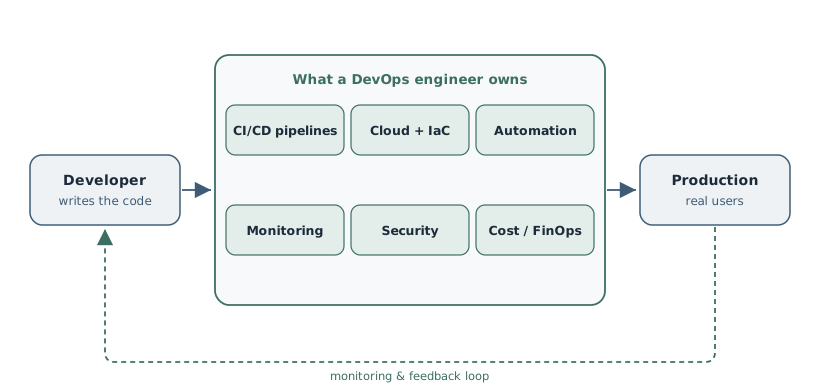
What a DevOps engineer owns: the path from a developer to production, and the feedback loop back.
In practice that breaks down into a handful of responsibilities:
CI/CD pipelines.
They build the automated path that takes a code change, tests it, and releases it, so shipping stops being a manual, nerve-wracking event. This is the core of the job, and what our CI/CD setup work is built around.
Cloud infrastructure and IaC.
They set up and manage where your software runs (AWS, Azure, or Google Cloud) and define it as version-controlled infrastructure as code rather than manual console clicks.
Automation.
Anything done by hand twice becomes a script: provisioning, deployments, backups, rollbacks.
Monitoring and reliability.
They make sure you find out about problems before your customers do, with the monitoring and observability to see what production is doing and why.
Security.
They bake security checks into the pipeline instead of bolting them on later, the practice known as DevSecOps.
Cost.
Increasingly, they own cloud spend too, right-sizing infrastructure and catching the runaway bills that quietly eat a startup's runway.
03What does a day in the life look like?
There is no standard day, which is part of the point, but a typical one blends building and firefighting.
A morning might go into building a new deployment pipeline for a service the team is launching. Then a monitoring alert fires: response times are creeping up on the checkout service. The DevOps engineer digs into the metrics and logs, traces it to a database running low on connections, and ships a fix. The afternoon goes to writing Terraform so a new environment can be created in minutes instead of a day, reviewing a pull request that touches infrastructure, and tightening a cloud budget alert so the next cost spike gets caught early. If they are on call that week, a 2am page is always possible.
The throughline is ownership. When a deploy fails or production goes down, it is their problem to solve, and their job to make sure it does not happen the same way twice.
04What skills and tools does a DevOps engineer use?
A good DevOps engineer is less defined by any single tool than by how they think about systems. That said, most roles expect fluency across these areas:
| Skill area | What it is for | Common tools |
|---|---|---|
Cloud platform | Where everything runs | AWS, Azure, Google Cloud |
CI/CD | Automating build, test, and deploy | GitHub Actions, GitLab CI, Jenkins |
Infrastructure as Code | Version-controlled infrastructure | Terraform, Pulumi, CloudFormation |
Containers and orchestration | Packaging and running services | Docker, Kubernetes, Helm |
Monitoring and observability | Seeing what production is doing | Prometheus, Grafana, Datadog |
Scripting | Gluing automation together | Python, Bash, Go |
Security (DevSecOps) | Catching issues in the pipeline | Snyk, Trivy, secret scanners |
The more important trait is systems thinking: understanding how the cloud, the pipeline, and the application behave together under load, failure, and change. In 2026, employers increasingly expect that architectural view plus a habit of automating with purpose, rather than a resume full of tool logos.
05DevOps engineer vs SRE vs platform engineer vs software engineer
These titles overlap, and in a small team one person often wears several hats, so the boundaries blur. Still, they focus on different things.
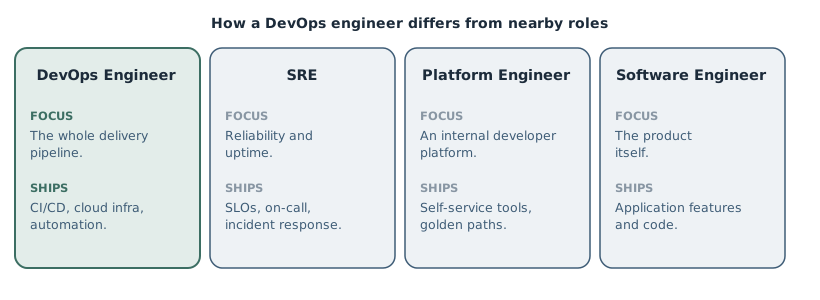
The same work, split across four roles as a company grows.
DevOps Engineer
Focus: The whole delivery pipeline.
Ships: CI/CD, cloud infra, automation.
SRE
Focus: Reliability and uptime.
Ships: SLOs, on-call, incident response.
Platform Engineer
Focus: An internal developer platform.
Ships: Self-service tools, golden paths.
Software Engineer
Focus: The product itself.
Ships: Application features and code.
A software engineer builds the product. A DevOps engineer builds the road that gets the product safely to users. A site reliability engineer (SRE) concentrates on keeping it up: reliability targets, on-call, and incident response. A platform engineer builds an internal, self-service platform so product engineers can ship without becoming infrastructure experts. At a 10-person startup, one DevOps hire usually covers most of this. At a 500-person company, these become separate teams.
06What does a DevOps engineer cost?
This is usually the real question behind "do I need one." Compensation is significant, because the skill set is in high demand. The ranges below are approximate 2026 figures and vary widely by location, company size, and equity, so treat them as a starting point and verify against a current source before you budget.
| Experience | United States (annual) | India (annual) |
|---|---|---|
| Entry (0 to 2 years) | $80,000 to $120,000 | ₹3 to 6 LPA |
| Mid (3 to 6 years) | $110,000 to $150,000 | ₹8 to 20 LPA |
| Senior (7+ years) | $140,000 to $200,000+ | ₹20 to 40+ LPA |
Note: US figures synthesized from Glassdoor, Built In, PayScale, and Coursera (2026). US median total comp commonly lands ~$140,000 to $150,000; senior all-in at large tech firms can exceed $200,000. India figures vary sharply by company type and city. All approximate; compensation data dates fast.
The gap between the two columns is why a lot of US startups work with an offshore or managed team instead of, or alongside, a full-time local hire. A mid-level engineer who would cost $130,000 in the US may cost a fraction of that through an India-based team, though the right comparison is total value and reliability, not just the headline rate. It is the model behind our managed DevOps service.
07Do you actually need a DevOps engineer yet?
The honest answer: Not every stage needs a full-time DevOps hire.
If you are pre-launch with no users, you do not. Your developers can lean on managed platforms and simple deploys, and your time is better spent finding product-market fit. What you want early is the cheap, high-leverage basics: an automated deploy, version-controlled infrastructure, backups, and a little monitoring.
You have likely reached the point of needing real DevOps help when a few of these are true: deploys are manual and slow enough that they are holding back releases, you have had avoidable downtime, cloud costs are climbing with no clear owner, your developers are spending significant time on infrastructure instead of product, or there is no one whose job it is to keep production healthy.
The catch for many startups is that they hit those signs before they can justify a $130,000 full-time hire, or before a single senior engineer would even stay busy and challenged. Which leads to the options.
08How do you get DevOps help: full-time, fractional, or managed?
There are three common ways to cover the work:
Full-time hire
The right move once DevOps is continuous, business-critical, and enough to fill a role. The cost and hiring difficulty are the trade-offs; mid-level engineers in the US often field multiple offers within days.
Fractional or contract
A senior engineer part-time. Good when you need expertise and setup but not 40 hours a week of it.
Managed DevOps
An outside team that owns your pipelines, infrastructure, and monitoring on an ongoing basis. This suits startups that need senior capability and coverage without the cost and overhead of building an in-house team.
Not sure which fits?
Our DevOps for startups page covers how managed DevOps works, or you can hire a DevOps engineer through us directly.
Book a free technical callWe will tell you honestly which one fits.
Contents
Frequently Asked Questions
Common questions about DevOps engineers
Quick answers to the most common questions.
01What does a DevOps engineer do day to day?
02Is a DevOps engineer a developer?
03Do DevOps engineers need to code?
04What is the difference between a DevOps engineer and an SRE?
05How much does a DevOps engineer cost?
06Does my startup need a DevOps engineer?
07Is being a DevOps engineer stressful?
Need senior DevOps without the full-time hire?
Book a free technical call and we will tell you honestly what is worth doing now and what can wait.
No pressure. Just a conversation to see if we're a good fit.