Direct answer, read this first
The DevOps skills that matter are a small durable core, not a long tool list: Linux and networking fundamentals, scripting (Python or Bash), version control, one cloud provider known deeply, CI/CD, infrastructure as code, containers and Kubernetes, monitoring, and security basics, plus the human skills, communication, ownership, and staying calm during an incident. Everything else is a tool you can learn on the job. Hire for the fundamentals and the judgment, because the specific tools keep changing.
01The short version
A good DevOps engineer is not someone who has touched the most tools. It is someone who understands systems well enough to keep software shipping safely, and who can pick up whatever tool the job needs because they understand the problem underneath it. The durable skills are the fundamentals: how computers, networks, and the cloud actually work; how to automate things reliably; and how to stay calm and methodical when production is on fire. Tools sit on top of that foundation and get swapped out every couple of years. Hire and learn for the foundation.
02The core technical skills
Here is the technical core, grouped the way it actually matters rather than as a flat list of forty items.
Foundations
Linux and OS, networking (DNS, HTTP/TLS, load balancing, firewalls), scripting (Python/Bash), Git
Cloud
One provider deeply (AWS, Azure, or GCP) - IAM, compute, networking, storage
Delivery
CI/CD pipelines, infrastructure as code (Terraform)
Runtime
Containers, Kubernetes, monitoring and observability
Security
DevSecOps basics: secrets management, least-privilege access, dependency scanning
2026 Additions
GitOps, cost awareness/FinOps, comfort with AI tooling
That is nine areas, not forty tools. A strong engineer is deep in a few of these and competent across the rest, and can learn the specific tool your stack uses in a week.
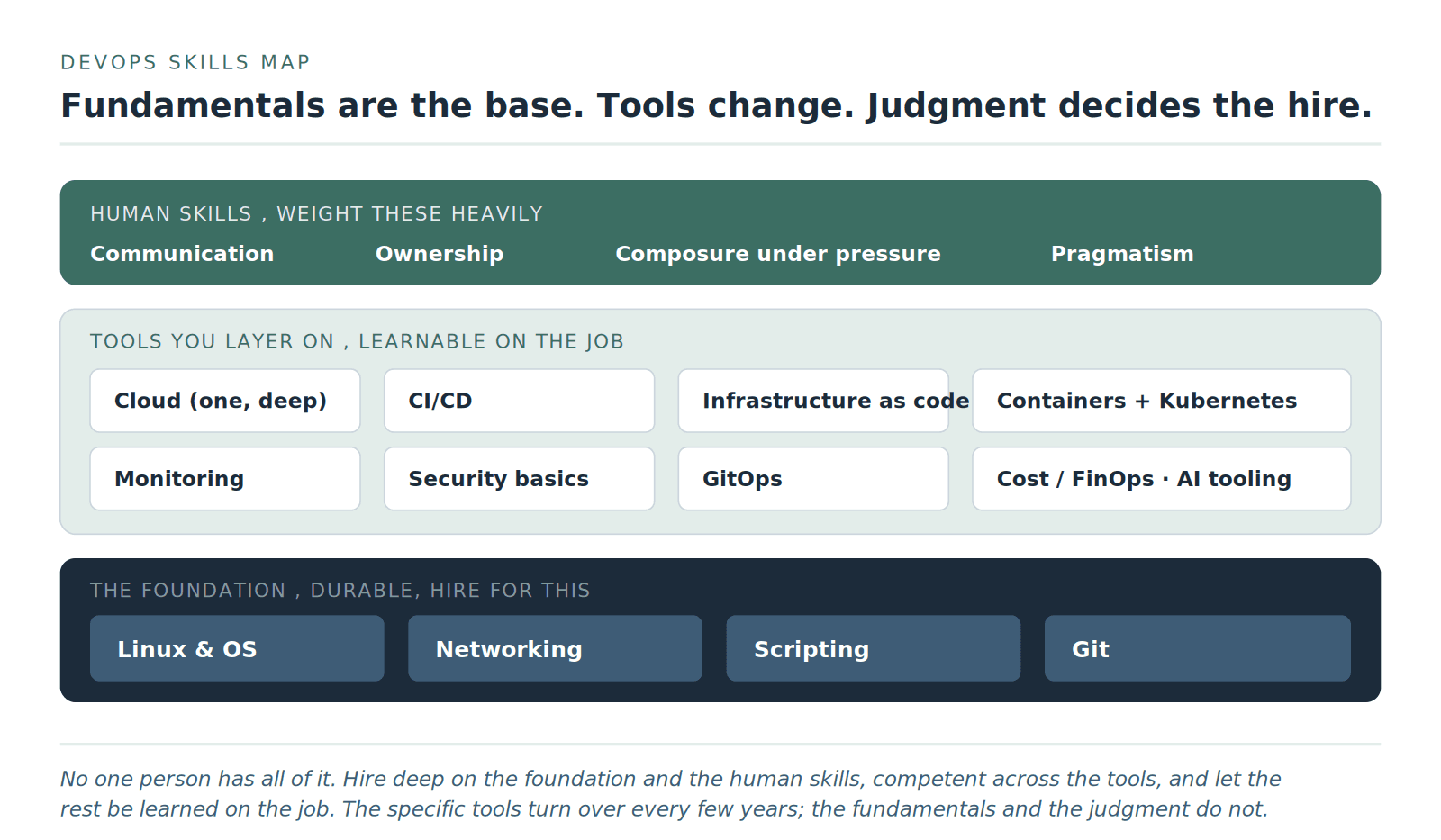
The foundation is durable and worth hiring for; the tools change every few years and can be learned on the job.
03The soft skills that separate good from great
This is the half of the checklist most job posts underweight, and it is usually what actually decides whether a hire works out.
Communication
A DevOps engineer sits between developers, operations, and the business, and translating between them is half the job.
Ownership
The "you build it, you run it" instinct that treats production as their responsibility rather than someone else's problem.
Composure under pressure
Incidents happen, and the person who stays methodical at 3am while everything is red is worth more than the one with an extra certification.
Pragmatism
Knowing what to skip, which is rarer and more valuable than knowing every tool.
Documentation and teaching
So the knowledge does not all live in one person's head.
You cannot certify any of these, which is exactly why they are the ones worth screening for hardest.
04What the role actually does day to day
Skills exist to serve responsibilities, so it is worth being clear on what the job involves: building and maintaining CI/CD pipelines, managing cloud infrastructure as code, running the container platform, keeping monitoring and alerting healthy, handling incidents and on-call, and steadily automating away manual work. We cover the day-to-day in depth in what a DevOps engineer actually does, so this guide stays focused on the skills behind those responsibilities.
05The checklist trap: why not to hire for 30 tools
Here is the mistake almost every DevOps job description makes. It lists every tool anyone on the team has ever used, Docker, Kubernetes, Terraform, Ansible, Jenkins, GitLab, ArgoCD, Prometheus, Grafana, and fifteen more, and then wonders why the shortlist is full of people who can recite tools but freeze the first time production breaks in a way the tutorial did not cover.
Hiring for a tool list selects for keyword-matching, not competence. It filters out a strong engineer who has run AWS deeply but not your exact monitoring stack, and lets through someone who has name-dropped all forty and mastered none. The deeper problem is that the list is the volatile part. The specific tools turn over every few years, and even the job title is shifting. What does not change is whether someone understands systems, automates reliably, and keeps their head in an incident. As one startup CTO put it bluntly, you hire for intent, not for a resume. Screen for the fundamentals and the judgment, and treat the tool list as "things a good engineer can pick up," because they can.
06What a startup's first DevOps hire actually needs
A startup's first DevOps hire is a different animal from the tenth person on an enterprise platform team, and hiring as if they are the same is a common, expensive error.
Your first hire will own the cloud platform, the developer experience, and the core infrastructure end to end, usually alone. That means breadth and ownership matter far more than deep specialization. You want someone who can stand up CI/CD, get infrastructure into code, keep costs sane, and make sensible calls about what to build now versus later, not a Kubernetes specialist who needs a team around them. Crucially, you want someone with the judgment to skip things: the first hire who insists on a full service mesh and multi-region Kubernetes for a pre-revenue product is a warning sign, not a catch. If you are weighing whether you even need this hire yet, our guide to DevOps for startups walks through the timing, and managed DevOps is a reasonable answer if you would rather not carry a full-time role yet.
07Junior vs senior: how the bar changes
The skill list barely changes between junior and senior. What changes is judgment.
A strong junior has solid fundamentals, competence with one or two of the core tools, and the eagerness to learn the rest. A senior has all of that plus the thing you cannot teach quickly: knowing which trade-off to make, when to say no to complexity, how to design a system that the rest of the team can operate, and how to stay calm and systematic when it all goes wrong. If you are comparing two candidates by counting tools, you are measuring the wrong axis. Count scars and judgment instead.
08How to become a DevOps engineer
If you are on the other side of this, trying to get into the field, the honest path is shorter than the roadmaps suggest and points at the same fundamentals. Learn Linux and networking properly. Pick one cloud and go deep. Get comfortable scripting and with Git. Then layer on CI/CD, infrastructure as code, and containers, and, most importantly, build real projects you can talk about, because a working pipeline you built beats a shelf of course certificates every time.
What to skip, at least at first: trying to learn all forty tools, and collecting certifications before you have the fundamentals they sit on. Depth in the core plus a couple of real projects will get you further than breadth across a tool list you have only watched videos about.
09Certifications: signal or noise?
Certifications are a signal, not proof. An AWS DevOps Engineer Professional, a Certified Kubernetes Administrator, or a HashiCorp Terraform Associate can help a resume clear the first filter, and the studying does teach real things. What they do not do is replace hands-on judgment, and a candidate with a couple of real systems they have built and broken and fixed will almost always outperform one with a wall of certificates and no production scars. Value them as a tie-breaker, not a requirement, and never let them stand in for evidence that someone can actually do the work.
10How the role is changing in 2026
Two shifts are worth knowing, and both reinforce the same advice. First, the role is evolving, not dying. The DevOps culture has spread into platform engineering, SRE, cloud, and security roles, so the title on the job post is less stable than it used to be, and "platform engineer" is increasingly the same job with a newer name. Second, AI is automating the routine parts, the YAML wrangling, the boilerplate pipelines, the first-draft scripts, which shifts the human job toward designing, reviewing, and supervising that automation rather than typing all of it by hand.
The through-line is that the tools and even the title are the churn, and the fundamentals are the constant. An engineer hired for judgment and systems understanding adapts to all of this. One hired for a 2024 tool list does not.
11The DevOps skills matrix
Here is the whole thing as a matrix you can drop into a job description or an interview scorecard. Treat the core as expected and the rest as bonus, and weight judgment and the human skills as heavily as the technical ones.
| Layer | Skills | How to weight it |
|---|---|---|
| Foundation | Linux and OS, networking, scripting (Python/Bash), Git | Expected. Hire for this; it is the durable part. |
| Cloud & Infrastructure | One cloud deeply, infrastructure as code, Docker, Kubernetes | Expected. Match Kubernetes depth to your real scale. |
| Delivery & Reliability | CI/CD, monitoring and observability, incident response, security basics | Expected. On-call temperament matters as much as the tools. |
| 2026 Additions | GitOps, cost awareness / FinOps, comfort with AI tooling | Increasingly expected, especially cost on a startup budget. |
| Human Skills | Communication, ownership, composure, pragmatism, documentation | Weight heavily. These usually decide whether the hire works out. |
If a candidate is strong on the foundations, deep in one cloud, and clearly has the human skills, do not reject them for missing a tool or two. Those are the cheapest gaps to close.
Hiring your first (or next) DevOps engineer?
We can help you scope the role honestly, or fill the gap ourselves while you do.
Contents
Frequently Asked Questions
Common questions about DevOps engineer skills
Quick answers to the most common questions.
01What skills does a DevOps engineer need?
02What are the most important DevOps skills?
03Do you need a degree or certifications to be a DevOps engineer?
04What is the difference between a junior and senior DevOps engineer?
05How long does it take to become a DevOps engineer?
06Do DevOps engineers need to know Kubernetes?
07Is DevOps a technical or a soft-skill role?
08Does a small startup need a dedicated DevOps engineer?
Not sure what to look for, or whether to hire at all?
Tell us about your stage and stack and we will give you an honest read, including if the answer is "not yet."
No pressure. Just a conversation to see if we're a good fit.