Direct answer, read this first
DevOps is a culture and set of practices for shipping software faster through collaboration and automation. SRE (site reliability engineering) applies software engineering to reliability, with measurable SLOs, error budgets, and disciplined incident response. Platform engineering builds an internal developer platform so teams can self-serve without wrestling infrastructure. Same tools, different missions. Most startups need one good DevOps generalist first, and add the other two only when scale forces the question.
01The short answer
DevOps optimizes flow, SRE optimizes reliability, platform engineering optimizes developer experience. That is the whole comparison in one line. They share tools (Kubernetes, Terraform, cloud, CI/CD, monitoring) and they overlap in practice, but each exists to solve a different problem, and knowing which problem you actually have is how you decide what to hire.
02What DevOps actually is
DevOps is the oldest of the three and the broadest. It started as a reaction to the wall between developers who wanted to ship and operations who wanted stability, and it is best understood as a culture and set of practices rather than a job title: collaboration between dev and ops, automation of everything repeatable, and an automated path from code to production. If you want the full version, we cover it in what DevOps actually is.
A DevOps engineer, in practice, is a generalist who builds and runs that path: CI/CD pipelines, infrastructure as code, cloud, containers, and monitoring. The remit is wide and shallow-to-deep depending on the team. At most companies, and nearly all startups, this is the role that quietly does a bit of everything the other two specialize in.
03What SRE actually is
Site reliability engineering is the most specific of the three, because it came from one place: Google, which described it as what happens when you ask a software engineer to run operations. Where DevOps optimizes for shipping, SRE optimizes for reliability, and it does so with real engineering rigor rather than good intentions.
SLO (Service Level Objective)
A concrete reliability target, for example 99.9% of requests succeed.
Error budget
The flip side: the small amount of unreliability you are allowed, which, when you spend it, means you stop shipping features and fix reliability instead.
Toil
The manual repetitive operational work that SREs are explicitly tasked with automating away.
An SRE protects the system; you feel their absence at 3am. This is the role you add when reliability stops being a nice-to-have and becomes something customers or contracts demand.
04What platform engineering actually is
Platform engineering is the newest of the three and the most misunderstood, partly because it is the current hype cycle. Stripped of the noise, it is straightforward: it builds an internal developer platform (an IDP), a self-service layer over your infrastructure so that developers can ship without having to understand Kubernetes, Terraform, networking, and security all at once.
The problem it solves is cognitive load. In a modern cloud-native setup, a single developer is expected to know an intimidating stack just to deploy a service. A platform team builds "golden paths," paved routes where a developer deploys through a simple interface and the platform handles the complexity underneath. The key mental shift is that the platform is treated as a product, and the developers are its customers. Platform engineering is widely described as the next evolution of DevOps, building on it rather than replacing it, and it earns its place when you have enough teams that everyone reinventing the same infrastructure has become the bottleneck.
05Side by side: what each one optimizes
Here is the comparison in one view. The rows that matter most are the first and the last: what each one optimizes, and when a startup actually needs it.
| DevOps | SRE | Platform Engineering | |
|---|---|---|---|
| Optimizes | Delivery flow | Reliability | Developer experience |
| Core question | How do we ship faster? | How do we stay reliable? | How do devs self-serve? |
| Key practices | CI/CD, IaC, automation | SLOs, error budgets, incidents | Internal platform, golden paths |
| Mindset | Culture and collaboration | Reliability engineering | Platform as a product |
| A startup needs it | Yes, first (as a generalist) | When reliability is critical | When many teams reinvent infra |
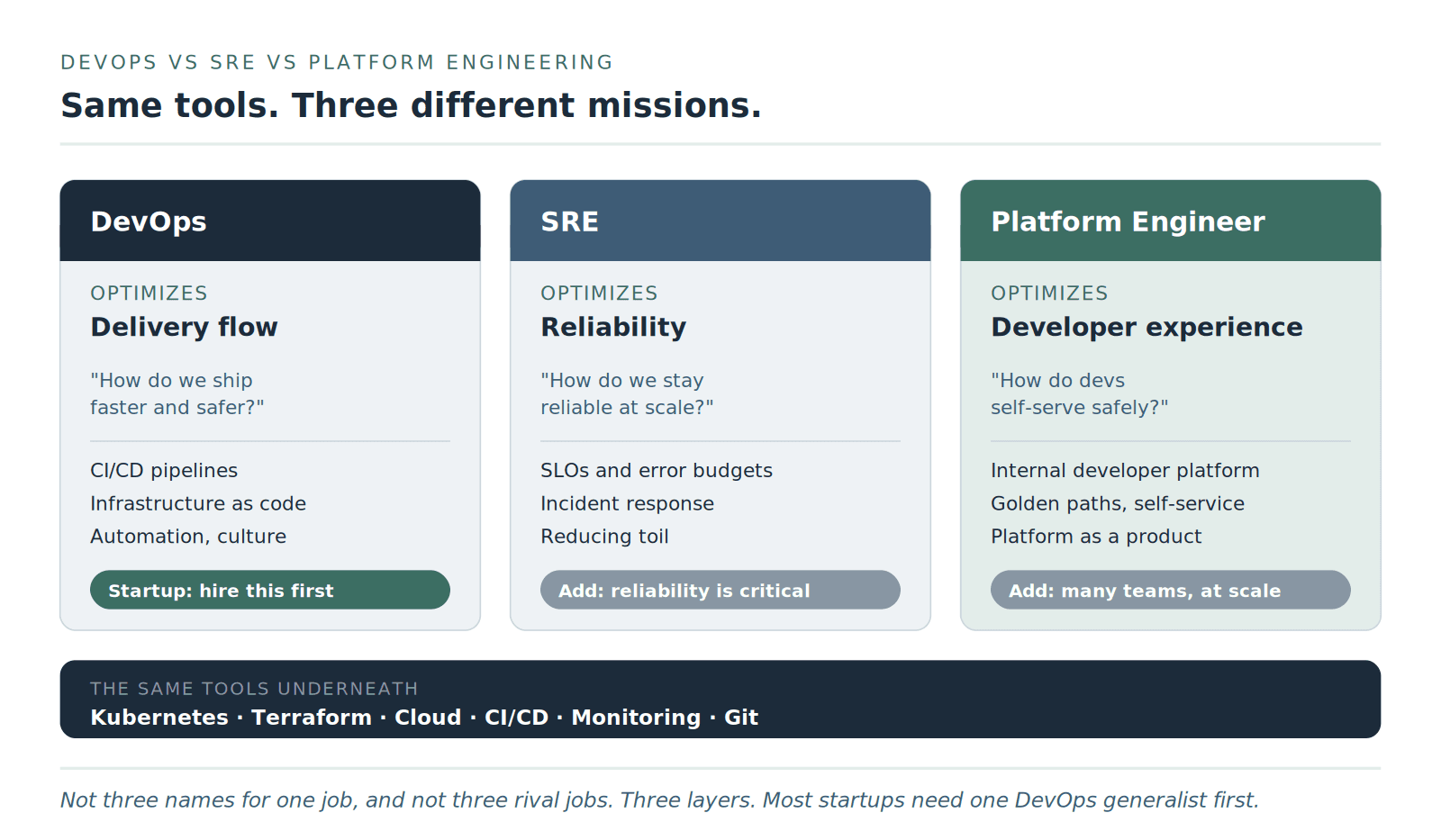
Three layers, not three rival jobs. They share tools; each optimizes something different. Most startups need one DevOps generalist first.
06How they overlap, and why companies build all three badly
In real life these roles bleed into each other. They use the same tools, they collaborate constantly, and at a small company one person genuinely does all three jobs before lunch. That overlap is why the titles get used interchangeably, and it is also where companies go wrong.
The common failure is building all three at once, badly: hiring an "SRE" who is really just a DevOps engineer with a bigger salary, standing up a "platform team" that builds an internal platform nobody asked for, and spreading three job titles across work that one focused role could have done better. The titles have become partly a salary-band and recruiting game, which is not a reason to ignore them, but is a good reason to hire for the problem in front of you rather than the label. If your developers are blocked on deploys, that is a DevOps or platform problem. If you are having outages you cannot explain, that is an SRE problem. Name the problem first, then pick the role.
07Which one does your company actually need?
This is the section the vendor and career blogs skip, and it is the one that matters if you are hiring. The honest answer for most companies reading this is: a DevOps generalist, and not the other two yet.
1-20 engineers: DevOps Generalist
"DevOps" often just means the developer who also SSHs into the server, and your first dedicated hire should be a generalist DevOps engineer who can own the whole path from code to production. You almost certainly do not need a dedicated SRE or a platform team at this stage; the overhead is not worth it, and a good generalist covers the reliability and tooling basics.
Add an SRE when...
Reliability becomes business-critical and you have enough scale to define meaningful SLOs, which is common in fintech, health, and anything with strict uptime contracts.
Reach for platform engineering when...
You have enough separate teams that each one reinventing the same infrastructure is genuinely slowing you down, and even then, a thin or managed platform usually beats standing up a full platform team on day one.
If you are weighing this for an early-stage company, our guide to DevOps for startups walks through the timing in more detail.
08So which should you hire?
For almost every startup and growing SaaS team, the first hire is a DevOps engineer, a generalist with the fundamentals and the judgment to keep things simple. We cover exactly what to look for in the DevOps engineer skills checklist.
You bring in SRE and platform specialists later, as specific pains (reliability, developer friction at scale) appear, not because a job board told you the titles exist. If you would rather not carry a full-time role yet, managed DevOps covers the same ground, and if you are ready to hire, we can help you scope the role and find the right engineer.
Not sure which of these you actually need?
Tell us your stage, team size, and what is hurting, and we will give you an honest answer, including if it is "one generalist, not three roles."
Talk to us092026: convergence, AI, and "is DevOps dead?"
Two things are worth knowing about where this is heading. First, no, DevOps is not dead, despite the headlines. What is happening is convergence: the DevOps culture has spread into SRE, platform, cloud, and security roles, so the boundaries are blurrier than ever, and at many companies the three are merging back into overlapping responsibilities rather than splitting into three separate teams. Second, AI is automating the routine parts of all three, the pipeline boilerplate, the YAML, the first-draft automation, which pushes every one of these roles toward the judgment-heavy work: designing systems, setting reliability targets, and deciding what to build versus buy. The tools and even the titles will keep shifting. The underlying skills, understanding systems and making good trade-offs, are what hold their value, which is exactly why you hire for those rather than for a title.
Contents
Frequently Asked Questions
Common questions about DevOps, SRE, and Platform Engineering
Quick answers to the most common questions.
01What is the difference between DevOps and SRE?
02Is SRE the same as DevOps?
03What is the difference between DevOps and platform engineering?
04Is platform engineering just DevOps rebranded?
05What is an internal developer platform?
06Does my startup need an SRE or a platform engineer?
07Is DevOps dead?
08Which should I hire, a DevOps engineer, an SRE, or a platform engineer?
Trying to figure out what to hire?
Tell us your stage and what is hurting, and we will give you an honest read, including if the answer is "one generalist, not three roles."
No pressure. Just a conversation to see if we're a good fit.