Direct answer, read this first
Infrastructure as code means building and managing your servers, networks, and databases with version-controlled code instead of manual setup. You describe the infrastructure you want, and a tool like Terraform, OpenTofu, or Pulumi makes reality match it. The payoff is consistency, speed, and an end to configuration drift, the slow divergence that happens when infrastructure is changed by hand.
01What problem does IaC solve?
Someone set up your production servers by clicking around the AWS console eight months ago. That person has since left. Now staging behaves differently from production, nobody is quite sure why, and rebuilding either one would take days of careful guesswork.
That slow divergence has a name: configuration drift.When infrastructure is changed by hand, every server gradually becomes a unique "snowflake" that no one fully understands, and the differences between environments quietly pile up until something breaks in production that worked everywhere else. Manual setup is also slow, hard to review, and impossible to repeat exactly.
Infrastructure as code attacks all of that by turning your infrastructure into text files. Because the setup lives in code, it can be reviewed, versioned, copied, and rebuilt identically, and drift becomes visible instead of invisible.
02What does infrastructure as code actually mean?
The core idea is simple: instead of configuring infrastructure through a web console or a series of manual commands, you describe it in code, and a tool makes reality match that description.
A small Terraform file might say "I want one web server of this size, in this region, with these firewall rules." You run the tool, and it creates exactly that. Change the file to say two servers, run it again, and it adds the second one. The code is the single source of truth for what your infrastructure should be, and it lives in version control alongside your application code, with the same reviews and history.
03Declarative vs imperative, and mutable vs immutable
When you adopt IaC, you run into two design choices worth understanding. The first is declarative vs imperative. This is the bigger one, and most modern tools are declarative.
| Declarative | Imperative | |
|---|---|---|
| You define | The end state you want | The exact steps to get there |
| The tool | Figures out how to reach it | Follows your steps in order |
| Example tools | Terraform, OpenTofu, Pulumi, CloudFormation | Chef, shell scripts (Ansible is mostly declarative) |
| Best for | Most infrastructure, the common choice | Fine control over a specific process |
The second choice is mutable vs immutable. Mutable infrastructure is updated in place (you patch the existing server). Immutable infrastructure is never changed after it is created; when you need a change, you build a fresh server from the code and replace the old one. Immutable is more predictable, because every server is built the same way from scratch, and it pairs naturally with IaC.
04IaC vs IaaS: what is the difference?
These get confused because they share three letters, so it is worth being clear. IaaS (infrastructure as a service) is a cloud model where a provider rents you virtual servers, storage, and networking, the raw building blocks. IaC (infrastructure as code) is a practice for provisioning and managing infrastructure through code. You often use IaC to manage IaaS resources, but they are different ideas: one is what you rent, the other is how you manage it. IaC also works on-premises, not just in the cloud.
05How does infrastructure as code work?
In practice, a typical IaC workflow has a few steps.
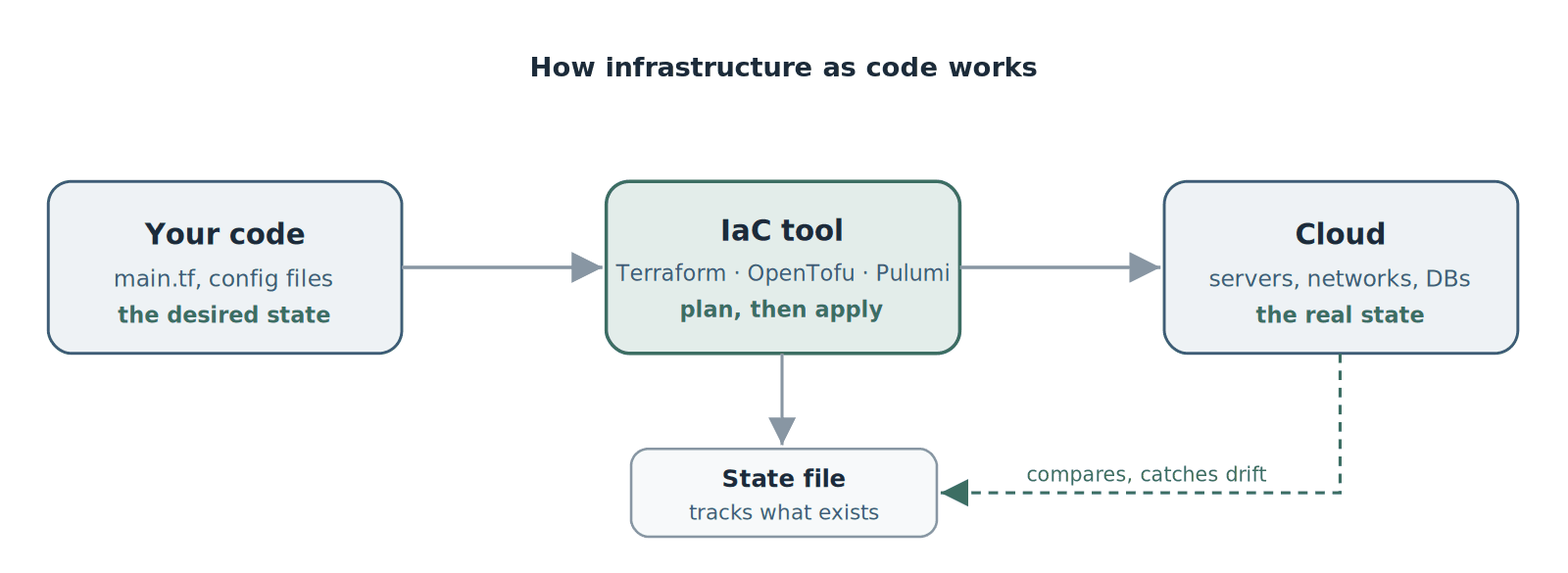
How IaC works: your code (desired state) feeds a tool that plans and applies changes, while a state file tracks reality and catches drift.
Write code.
You write code describing the infrastructure you want.
Plan.
The IaC tool runs a plan, showing you exactly what it will create, change, or destroy before anything happens.
Apply.
You review that plan, then apply it, and the tool talks to your cloud provider's APIs to make it real.
Track state.
Throughout, the tool keeps a state file that records what it has built, so it can compare the code against reality and show you any drift.
It fits naturally into a CI/CD pipeline, so infrastructure changes get tested and reviewed like any other code.
06What are the benefits of IaC?
Consistency.
Every environment is built from the same code, so staging actually matches production.
Speed.
Spinning up a new environment takes minutes, not days of manual setup.
Version control.
Infrastructure changes get reviewed, tracked, and rolled back like any code change.
No more drift.
The code is the source of truth, so differences become visible and fixable.
Disaster recovery.
If something is destroyed, you rebuild it exactly from the code.
Lower risk.
The plan step shows you what will change before it changes.
For a startup, the practical payoff is that one engineer can manage far more infrastructure, reliably, and a new hire can understand the whole setup by reading the code instead of interviewing whoever built it. Getting this right is the core of our infrastructure as code work.
07Which IaC tool should you use in 2026?
The tool landscape shifted more in the last three years than in the decade before, so if your last impression was "just use Terraform," here is what changed.
In August 2023, HashiCorp relicensed Terraform from an open-source license to the Business Source License (BSL), which is source-available but restricts building competing products. The community responded within weeks by forking Terraform into OpenTofu, an open-source, drop-in alternative now governed by the Linux Foundation, which reached general availability in January 2024. Then, in February 2025, IBM completed its acquisition of HashiCorp (a deal valued at roughly $6.4 billion), and the license has not reverted to open source. Meanwhile Pulumi kept letting you write infrastructure in real programming languages instead of a dedicated configuration syntax.
| Tool | Language | License | Best for |
|---|---|---|---|
Terraform | HCL | BSL, source-available (IBM/HashiCorp) | The largest ecosystem and talent pool |
OpenTofu | HCL | MPL 2.0, open source (Linux Foundation) | Teams that want an open, drop-in Terraform |
Pulumi | Python, TypeScript, Go | Apache 2.0, open source | Teams who prefer real programming languages |
CloudFormation | YAML or JSON | Proprietary (AWS) | Teams committed fully to AWS |
The honest summary: Terraform is still the most widely deployed and has the largest provider ecosystem and talent pool, so it is not going anywhere. OpenTofu is the natural pick for new projects that want an open-source guarantee, and because it is a drop-in fork, migrating is usually low-risk. Pulumi suits teams who would rather write infrastructure in a language they already know. For most startups, the choice between Terraform and OpenTofu is now the more consequential decision, and it is one we help teams make in our Terraform consulting work.
08Do you need IaC, and how do you start?
If you have more than a couple of servers, or more than one environment, the answer is almost certainly yes. Manual setup stops scaling quickly, and the cost of drift only grows.
The way to start is small. Do not try to codify your entire existing infrastructure in one weekend. Pick one new environment or one service, define it in code, and get comfortable with the plan-and-apply loop. Put the code in version control from day one, and expand from there as the habit sticks. The goal early on is simply to stop making changes by hand.
Get your infrastructure under control
Want your infrastructure set up as code correctly from the start, or an existing manual setup brought under control? That is what our infrastructure as code and managed DevOps work are for.
Book a free technical callWe will tell you what is worth doing now and what can wait.
Contents
Frequently Asked Questions
Common questions about infrastructure as code
Quick answers to the most common IaC questions.
01What is infrastructure as code in simple terms?
02Is Terraform infrastructure as code?
03What is the difference between IaC and IaaS?
04What language is used for infrastructure as code?
05What is configuration drift?
06Is infrastructure as code hard to learn?
07Do small teams need IaC?
Need help getting IaC set up right?
Book a free technical call and we will tell you honestly what is worth doing now and what can wait.
No pressure. Just a conversation to see if we're a good fit.