Direct answer, read this first
The DevOps lifecycle is one continuous loop of eight phases: plan, code, build, test, release, deploy, operate, monitor. The first four are the development side, the last four the operations side, and monitoring feeds straight back into planning. Some models draw it as six or seven phases; there is no official count. The value is not in the number, it is in automating the painful stretches of the loop.
01The short version
The DevOps lifecycle is the continuous loop your software moves through, from idea to production and back again: plan, code, build, test, release, deploy, operate, monitor. What monitoring learns feeds the next round of planning, which is why it is drawn as a loop with no end.
The point of naming the phases is not bureaucracy. It is so that when something breaks, or someone asks "whose job is this," you have a shared map. Everything belongs to the loop.
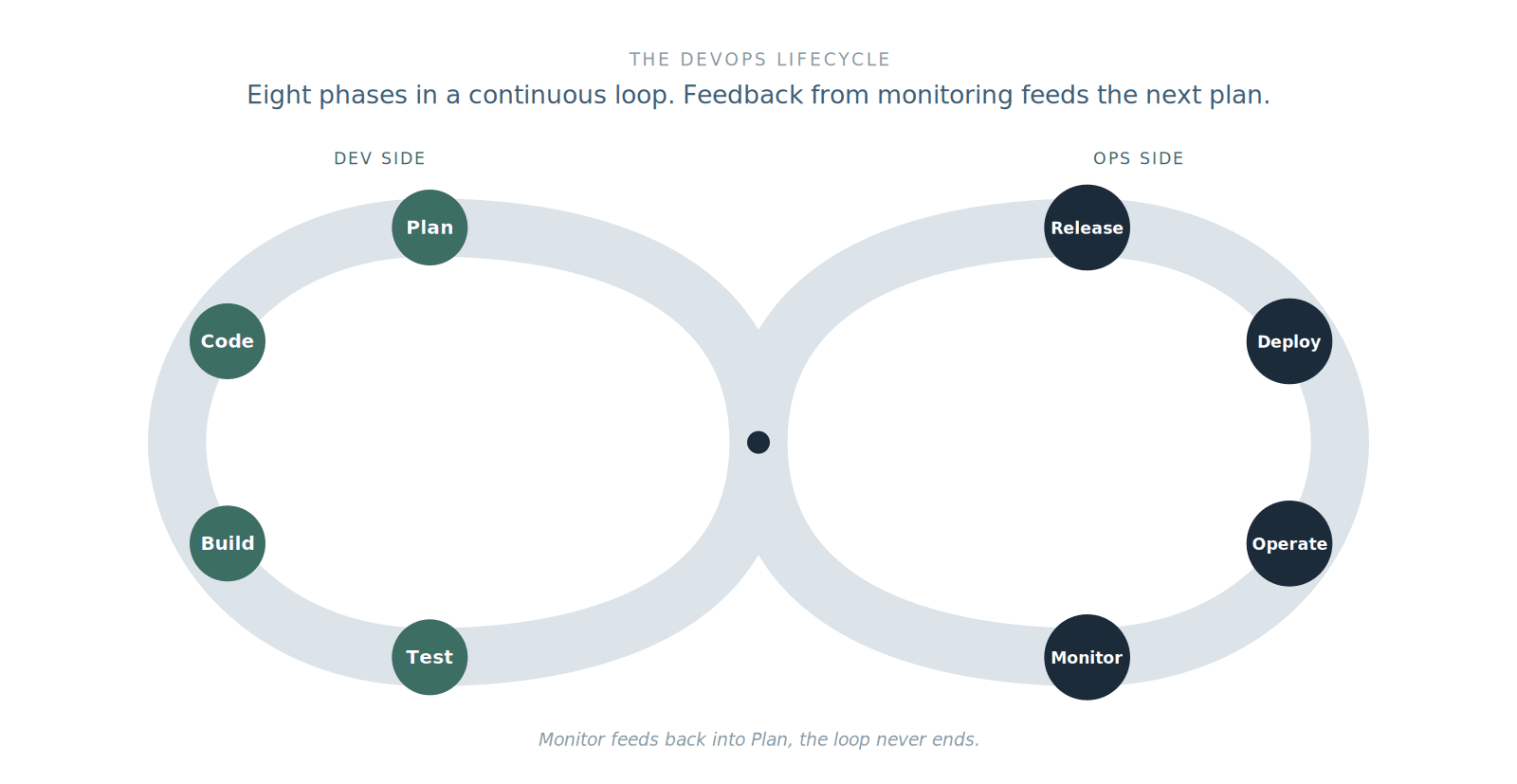
The lifecycle as an infinity loop. Development phases on the left, operations on the right, joined in the middle. Monitoring feeds back into planning, so the loop never ends.
02Why it is a loop, not a line
Traditional software development was a line: gather requirements, design, build, test, ship, then hand it to someone else to keep alive. Each step finished before the next began, and operations was something that happened after development was "done."
DevOps replaced that line with a loop, and the shape is the whole idea. The output of the last phase, monitoring, becomes the input of the first, planning. A slow endpoint spotted in production this week becomes a backlog item next week. A spike in errors after a deploy triggers a rollback and a post-mortem that shapes the next sprint. Nothing is ever "done and handed off," because the team that builds it is the team that runs it.
That is why you will almost always see the lifecycle drawn as an infinity loop rather than a checklist. The figure-eight is not decoration; it is a reminder that the work comes back around.
03The eight phases, one by one
Here is what each phase actually does, and the kind of tools you will see in it. Treat the tools as examples, not requirements. Nobody uses all of them, and the right stack depends on your team.
| Phase (side) | What actually happens | Example tools |
|---|---|---|
DevPlan | Decide what to build and why. Backlog, priorities, requirements. | Jira, Linear, Trello |
DevCode | Write the code, under version control from the first line. | Git, GitHub, GitLab |
DevBuild | Compile and package the code into a runnable artifact on each change. | Jenkins, GitHub Actions |
DevTest | Run automated tests against the build to catch problems before users do. | Jest, Selenium, PyTest |
OpsRelease | Declare a build production-ready and move it toward deployment. | GitHub Actions, Argo CD |
OpsDeploy | Put the release into production, ideally with zero downtime. | Kubernetes, Terraform |
OpsOperate | Keep the running system healthy: scaling, infrastructure, incidents. | Kubernetes, Ansible, AWS |
OpsMonitor | Watch production behavior and feed what you learn back to Plan. | Prometheus, Grafana, Datadog |
Note:Example tools only, not endorsements or requirements. The four left-side phases are traditionally "Dev," the four right-side "Ops," but in a real DevOps team the same people own the whole loop.
The two halves matter. The left side (plan, code, build, test) is where a change is created and proven. The right side (release, deploy, operate, monitor) is where it goes live and gets kept alive. In a functioning DevOps team, those are not two groups handing work over a wall. They are one team walking the whole loop, which is the entire point of the word "DevOps."
Several phases have their own deep mechanics. The build-test-release middle is what CI/CD automates. The deploy-operate stretch is where infrastructure as code lives. And the monitor phase is a discipline of its own, covered in monitoring and observability.
04How many phases are there, really?
Here is the honest answer most guides skip: it depends on who you ask, and there is no official number.
Some models list six phases. Some list seven, and even the sevens disagree with each other: one common version uses seven "C's" (continuous development, integration, testing, and so on), which do not map one-to-one onto the plan-code-build-test names. Plenty of major sources, including Atlassian, use eight.
We have used eight here because separating Release from Deploy, and Operate from Monitor, reflects how production actually works, especially anywhere a release approval is a distinct step from the deployment itself. But if you see a diagram with six or seven, it is not wrong. It is the same loop drawn at a different resolution.
The reason to care is not the count. It is that anyone presenting their number as the number is telling you something about how carefully they have read the field. The phases are a shared vocabulary, not a law of physics.
05Lifecycle, pipeline, workflow: the difference
Three terms get used as if they are the same thing. They overlap, but they are not identical, and the confusion causes real miscommunication.
| Term | What it means | Scope |
|---|---|---|
| DevOps Lifecycle | The full conceptual loop, plan through monitor, including culture and feedback | Broadest |
| DevOps Pipeline | The automated tooling that moves code through build, test, and deployment | A subset of the lifecycle |
| DevOps Workflow | How a specific team actually works day to day within the lifecycle | Team-specific |
The short version: the lifecycle is the map, the pipeline is the automated machinery inside it, and the workflow is how your particular team walks it. When someone says "our DevOps pipeline," they usually mean the CI/CD automation, not the whole loop.
06Where security fits: DevSecOps and shifting left
In the old model, security was a gate at the end, a review right before release that everyone dreaded and nobody had time for. The modern approach threads it through every phase instead, which is what "DevSecOps" and "shift left" mean.
In practice that looks like threat modeling in the Plan phase, secret scanning and secure-coding checks in Code, automated security scans in Build, and vulnerability testing before Deploy. The principle is simple: the earlier you catch a security problem, the cheaper it is to fix, and bolting security on at the end has always been the expensive way to do it.
You do not need a separate security team to start. You need a few automated checks in the phases you already have. That is the entry point to DevSecOps, and it is far more achievable for a small team than the word makes it sound.
07What this looks like for a startup
You do not implement "the lifecycle" as a project. You already have all eight phases, whether you have named them or not: you plan something, someone codes it, it gets built and tested somehow, and it ends up in front of users who then have opinions. The question is only how much of that is automated and how much is manual and stressful.
The practical path is to automate the loop one stretch at a time. Start with the build-test-release middle, that is CI/CD, and it is usually where the most pain is. Then get deploy and operate onto reproducible infrastructure as code. Then make the monitor phase real, so feedback actually reaches your planning instead of arriving as an angry customer email.
You do not need a platform team to do this well. You need someone who has walked the loop before. That can be a DevOps engineer you hire, or managed DevOps if you would rather keep your engineers on the product.
Not sure which phase is costing you most?
Tell us where the loop hurts, slow releases, painful deploys, blind spots in production, and we will help you find it and fix it.
Book a free technical callContents
Frequently Asked Questions
Common questions about the DevOps lifecycle
Quick answers to the most common questions.
01What is the DevOps lifecycle?
02What are the phases of the DevOps lifecycle?
03Why is the DevOps lifecycle shown as an infinity loop?
04How many phases are in the DevOps lifecycle?
05What is the difference between the DevOps lifecycle and a DevOps pipeline?
06Where does security fit in the DevOps lifecycle?
07What tools are used in the DevOps lifecycle?
08Do I need to follow all eight phases?
Want help automating your loop?
Tell us which phase is costing you most and we will give you an honest plan to fix it.
No pressure. Just a conversation to see if we're a good fit.