The short version
Use ECS if you are AWS-native, have a small team, and do not need Kubernetes; it is simpler and has no control-plane fee. Use EKS if you specifically need Kubernetes: its ecosystem, portability, or advanced orchestration. And remember the second, separate decision: Fargate (serverless, no servers to manage) versus EC2 (cheaper at steady scale) is your compute choice under either one. For most startups, ECS plus Fargate is the right place to start.
01The short answer: the decision in one rule
Here is the rule. If you are committed to AWS, your team is small, and your workloads are straightforward web services, APIs, and background jobs, choose ECS. It is AWS's own container orchestrator, it is simpler to operate, and it does not charge a control-plane fee. If you specifically need Kubernetes, because you want its ecosystem of tools, multi-cloud portability, or advanced scheduling and multi-tenancy, choose EKS.
Notice what that rule is really asking: do you need Kubernetes? If the honest answer is no, ECS is the lower-complexity, lower-cost choice, and you should take it. If yes, EKS gives you real Kubernetes with AWS running the hard part for you. The rest of this guide is detail on top of that one question, plus the separate compute decision we will get to in section 4.
02What ECS is
Amazon ECS (Elastic Container Service) is AWS's own container orchestrator, built around Docker. You define your containers as a task, group tasks into services, and ECS runs and scales them for you. Because it is AWS-native, it integrates cleanly with the rest of AWS: IAM roles attach directly to tasks, load balancing goes through the Application Load Balancer, logs and metrics flow into CloudWatch, and each task can get its own network interface and security group.
The appeal of ECS is simplicity. There is no control plane for you to think about, no cluster fee, and far less to learn than Kubernetes. For a team that is all-in on AWS and does not need Kubernetes-specific features, ECS gets you from container image to running service with the least ceremony. AWS documents it in the ECS documentation.
03What EKS is
Amazon EKS (Elastic Kubernetes Service) is AWS's managed Kubernetes. It runs standard, upstream Kubernetes, and AWS operates the control plane for you: the API server, the scheduler, and the datastore that keeps Kubernetes running. You bring the worker nodes (or run your pods on Fargate, more on that next). Because it is real Kubernetes, you get the entire Kubernetes ecosystem: Helm charts, Karpenter for scaling, service meshes, operators, and the same manifests you could run on any other cloud.
That power is also the trade-off. Kubernetes has a genuinely steep learning curve, cluster upgrades need planning, and there is more to operate even with AWS handling the control plane. EKS is the right tool when you need Kubernetes; it is a lot of machinery when you do not. AWS documents it in the EKS documentation. Because EKS is managed Kubernetes, our Kubernetes consulting team spends a lot of time helping teams decide whether they are ready for it.
04Where Fargate fits (it is compute, not an orchestrator)
This is the single most useful thing to understand, and the point most comparisons blur. Fargate is not an alternative to ECS or EKS. It is a serverless compute engine, and it runs under both of them. So there are actually two separate decisions:
Orchestration:
ECS or EKS.
Compute:
Fargate or EC2.
With Fargate, you do not manage any servers; you tell AWS how much CPU and memory each container needs and it runs them, and you pay for exactly that. With the EC2 launch type, you run and manage the underlying instances yourself, which is more work but cheaper for large, steady workloads because you can pack them efficiently and use Spot and Savings Plans.
So "ECS vs EKS vs Fargate" is a slightly wrong question. The real shape is ECS-or-EKS for orchestration, and Fargate-or-EC2 for compute, in any combination. ECS on Fargate is the simplest of all; EKS on EC2 gives you the most control.
05ECS vs EKS, side by side
Here is the direct comparison across the dimensions that usually decide it.
| Dimension | ECS | EKS |
|---|---|---|
| What it is | AWS's own container orchestrator | Managed Kubernetes on AWS |
| Portability | AWS-only | Standard Kubernetes, portable across clouds |
| Complexity | Lower, quick to learn | Higher, steep Kubernetes learning curve |
| Control-plane fee | None | Per-cluster fee (see section 8) |
| Ecosystem | AWS-native services | Full Kubernetes ecosystem (Helm, operators, meshes) |
| Compute options | Fargate or EC2 | Fargate or EC2 |
| Best for | AWS-native teams that do not need Kubernetes | Teams that specifically need Kubernetes |
06The real differences that matter
Beyond the table, a few differences drive the decision in practice.
Complexity and operations.
ECS is meaningfully simpler. With ECS on Fargate there are no nodes to patch, no cluster upgrades, and no Kubernetes concepts to learn. EKS, even managed, means running Kubernetes: upgrades on AWS's release cadence, node management (unless you use Fargate), and the general operational weight of the platform. For a small team, this difference is large.
Portability.
EKS runs standard Kubernetes, so in principle you can move workloads to another cloud's Kubernetes with far less rework. ECS is AWS-only. This is the headline argument for EKS, but be honest with yourself about whether you will actually use it. Many teams adopt EKS for portability and then never leave AWS, paying the extra cost and complexity for an option they never exercise.
Ecosystem and features.
If you need Helm, Karpenter, a service mesh, custom operators, or namespace-level multi-tenancy, that is Kubernetes, and EKS is how you get it on AWS. If your needs are standard services and jobs, ECS covers them without the extra surface area.
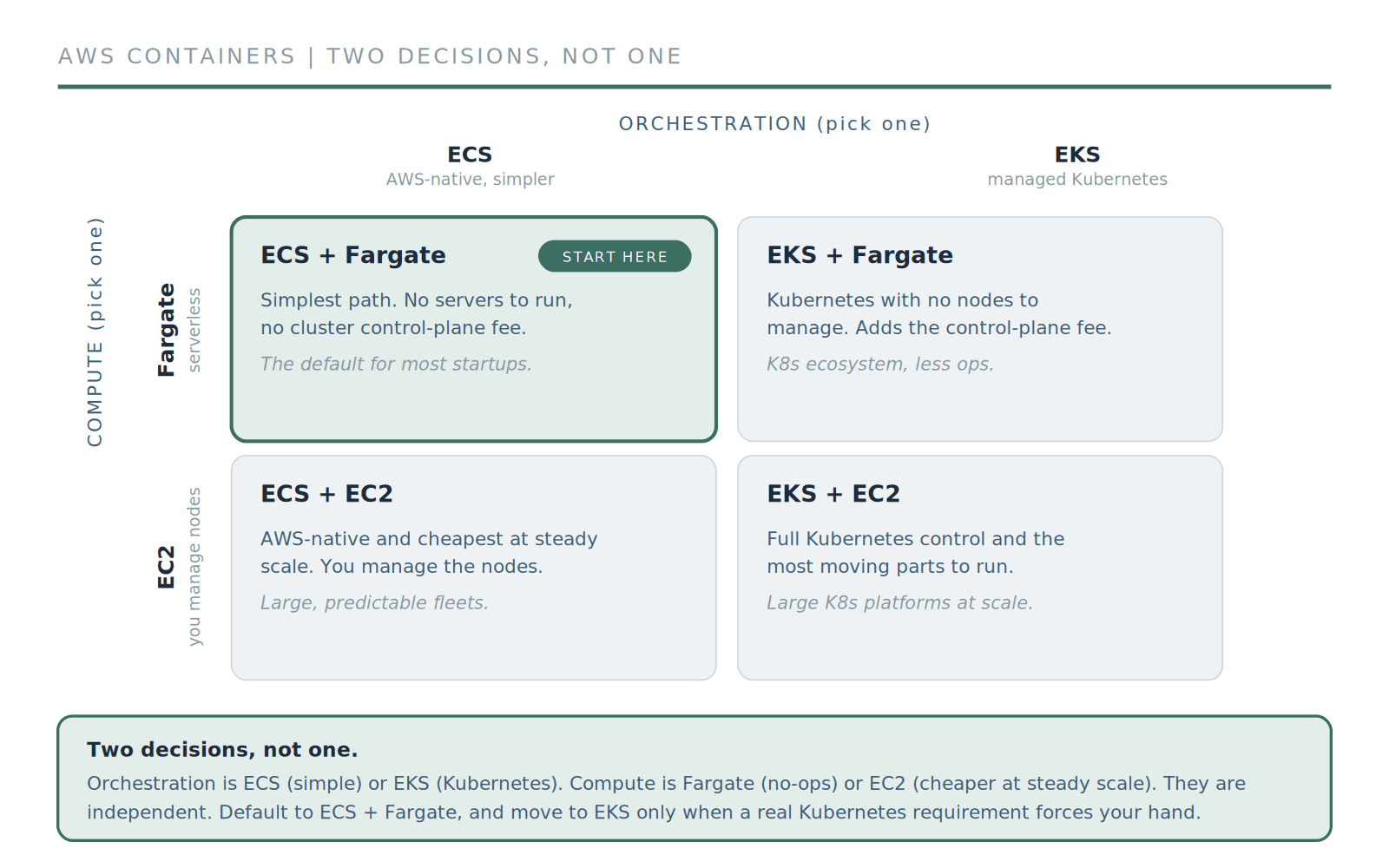
Two decisions, not one. Pick your orchestration (ECS or EKS) and your compute (Fargate or EC2) separately. For most startups, ECS plus Fargate is the right starting point.
07Do you actually need Kubernetes?
Because choosing EKS is really choosing Kubernetes, this is the question that should drive your decision, and it is the same one we cover in our Docker vs Kubernetes guide. Kubernetes is powerful and genuinely worth it at scale, but it carries real operational weight, and adopting it before you need it is a common and expensive mistake.
You have a real reason to reach for EKS when:
You need the Kubernetes ecosystem specifically (Helm, operators, service meshes).
You genuinely need multi-cloud portability.
Multiple teams need namespace-level isolation on shared infrastructure.
You have advanced scheduling needs that ECS cannot express.
If none of those apply, and for a lot of early-stage teams none do, ECS is the better choice, and ECS on Fargate is the simplest path to production there is. When your needs grow into Kubernetes, you can move, and our AWS DevOps services team helps teams make that call at the right time rather than too early.
Weighing ECS against EKS for your workload?
We help startups pick the simplest AWS container setup that will hold, and reach for Kubernetes only when it earns its keep.
AWS DevOps services08Cost: the control-plane fee, and Fargate vs EC2
Cost splits along the same two axes. At the orchestration layer, ECS has no control-plane fee, while EKS charges for its managed control plane: as of 2026, roughly 0.10 US dollars per hour per cluster, about 73 dollars a month, before you run a single container. Always confirm the current figure on the AWS pricing page, but the shape holds: EKS starts with a fixed monthly cost that ECS does not have. On a small service that overhead is a noticeable percentage of the bill; at large scale, spread across a big fleet, it becomes negligible.
At the compute layer, the cost is the same whether you are on ECS or EKS: Fargate is priced per vCPU and per GB of memory, identically on both, and EC2 is priced as normal EC2. The real compute trade-off is Fargate versus EC2, not ECS versus EKS. Fargate costs a premium for the convenience of managing no servers; the EC2 launch type is cheaper for large, steady workloads where you can pack instances efficiently and use Spot and Savings Plans. A practical pattern: start on Fargate for simplicity, and move steady baseline load to EC2 later if the compute bill grows enough to justify the operational work. For what an engineer to run all this costs, rather than the infrastructure, see our upcoming DevOps engineer salary guide; we keep those numbers out of this piece so they stay current.
09Migrating between ECS and EKS
Most migrations go one direction: a team starts on ECS and later moves to EKS when a real Kubernetes need appears. It is doable, but it is not a lift-and-shift, because the two use different APIs and models. You convert ECS task definitions into Kubernetes manifests, rebuild your networking and load-balancing configuration the Kubernetes way, and update your CI/CD pipelines to deploy to the cluster. The good news is that your container images are completely portable; it is the orchestration configuration around them that you rebuild.
Plan for real engineering time here, usually weeks rather than days depending on how many services you run and how complex they are, and migrate incrementally rather than all at once. If you would rather not run that migration yourself, our managed DevOps services and AWS DevOps teams do exactly this kind of work.
Contents
Frequently Asked Questions
Common questions about AWS ECS and EKS
Quick answers to the most common questions.
01Is EKS just Kubernetes?
02What is the difference between ECS and EKS?
03Do I actually need EKS?
04How much does the EKS control plane cost?
05Is Fargate an alternative to ECS and EKS?
Not sure whether ECS or EKS fits your stack?
We help startups pick the simplest AWS container setup that will actually hold, and move to Kubernetes only when the need is real.
No pressure. Just a conversation to see if we're a good fit.